
The Ascended Savior - Acts 1:6-11
At Christmas, we reflect upon the reality of the incarnation. On Good Friday we remember Christ’s crucifixion. On Easter, we consider his resurrection. We have special days for all these major events in Jesus’ life and ministry. And yet, for whatever reason, in most Protestant, Evangelical circles, the Ascension isn’t a day that is typically celebrated. Other branches of Christendom will, but we typically don’t.


And I can’t help but wonder if it’s because we generally think of the Ascension as nothing more than Christ's departure. The Ascension was when Jesus disappeared into the sky.
But the truth is, the Ascension is an incredibly important moment in redemptive history because it was Christ’s royal coronation. It’s the part that Paul refers to in Philippians 2 when he says, “Therefore God has highly exalted him and bestowed on him the name that is above every name, so that at the name of Jesus every knee should bow, in heaven and on earth and under the earth, and every tongue confess that Jesus Christ is Lord, to the glory of God the Father.”
The cross was the place of Christ's humiliation, where He willingly took upon Himself the form of a servant and became obedient to the point of death—even death on a cross. The ascension marks the beginning of His exaltation. The crucified Savior is now the exalted King, reigning in heaven and one day every knee bows and every tongue confesses that He is Lord.
The ascension is significant because it is Christ's royal coronation. Having accomplished the work the Father gave Him to do, the risen Christ ascends into heaven and is enthroned at the right hand of God the Father Almighty.
We learn several things from this passage: First, we learn that the Ascended Savior reorients his disciples (vv. 6-7), second, he sends his witnesses (v. 8), and lastly, he reigns until he returns (vv. 9-11).
The Ascended Savior Reorients his Disciples (vv. 6-7)
It’s important to remember what Jesus said up to this point. Jesus had told the disciples in verse 4, “not to depart from Jerusalem,” because they were going to be baptized by the Holy Spirit.
It’s important to remember that because I think it helps us understand their question in verse 6: “Lord, will you at this time restore the kingdom to Israel?”
In other words, “is now the time that you will make Israel great again?” After all, Jesus had said, don’t leave Jerusalem because I’m about to send the Spirit!
So in their minds, they’re thinking that Jesus is about to begin some sort of political revolution. He would liberate them from Roman rule and restore Israel to prominence, and usher in the Messianic kingdom. And of course, they thought they would play a major role in the kingdom that Jesus would establish.
And you know, this is something that really pops up throughout the gospels, because whenever Jesus would talk about the kingdom, his disciples would always get confused. Was it a spiritual kingdom or an earthly political kingdom? And in one sense the answer is actually both.
Christ's kingdom had already been inaugurated as a spiritual kingdom, conquering hearts rather than nations. Yet one day, Christ will return in power to consummate His kingdom, renew the heavens and the earth, and reign openly over all creation. The apostles understood pieces of that glorious plan, but they had not yet grasped how those pieces fit together. They expected the earthly kingdom immediately, but they did not yet understand God's redemptive timetable.
To be fair, the disciples weren't entirely wrong. They had correctly concluded that Christ's kingdom would one day be fully established. Their mistake wasn't expecting the kingdom—it was expecting Jesus to share with them the Father's timetable. Their question was, "Will you at this time?"
But Jesus shifts the conversation away from the timetable. He wasn’t going to engage in idle speculation because the exact date and time of when Christ will come again in power to establish his kingdom here on earth wasn’t any of their business. It was and still is the business of the Father. The secret things belong to the Lord.
I think most of us understand that, but consider the number of people who over the course of the last 2,000 years have tried to predict Christ’s return. It’s a fool’s errand. Jesus literally says, “don’t worry about that.”
The struggle most of us have isn’t with knowing the date and time of Christ’s return, the struggle is more with the fact that there are things God has not chosen to tell us. We want to know why suffering enters our lives. We want to know what tomorrow holds. We want to know how every decision will turn out. We want certainty about the future.
But there are some questions that belong to the secret counsel of God. Faith does not require knowing everything God knows. Faith requires trusting the God who does know everything. The disciples wanted a timetable; but instead, Jesus gave them a mission. Rather than speculating about what the Father has kept hidden, they were to devote themselves to what Christ had made abundantly clear.
The Ascended Savior Sends His Witnesses (v. 8)
Jesus tells his apostles exactly where to direct their interest and energy. “But you will receive power when the Holy Spirit has come upon you, and you will be my witnesses in Jerusalem and in all Judea and Samaria, and to the end of the earth.”
It’s reminiscent of the Great Commission isn’t it? Matthew 28 says, “Go therefore and make disciples of all nations…” And Luke records here, “You will be my witnesses…to the end of the earth.”
In fact, many scholars consider Acts 1:8 to be the thesis statement of the entire book. It’s essentially an outline for the book of Acts. In Acts chapters 1-7, we see the spread of the gospel in Jerusalem, then in chapters 8-12 it expands into Judea and Samaria, and then it advances to the ends of the earth through Paul's missionary journeys in chapters 13–28.
By the end of the book, Paul is proclaiming the gospel to Roman rulers in the heart of the Roman Empire—ultimately proving that Christ's kingdom is advancing exactly as Jesus promised. The kingdom is beginning to spread all over the world!
But look again at what is said in verse 8: “But you will receive power when the Holy Spirit has come upon you…” In other words, the power that was required to accomplish such a daunting task like taking the gospel to the ends of the earth wasn’t going to be something that they were going to accomplish through their own natural abilities. In fact, the task was impossible under the power of their own strength. The expansion of the kingdom of God was dependent upon them receiving power from the Holy Spirit.
Which directly challenges our natural inclinations doesn’t it? How easy is it for us to believe that in order to spread the gospel we need a slick outreach strategy or build the perfect worship service. And what happens if we’re not careful is suddenly we’re not dependent upon the Spirit for anything. We’ve become entirely self-reliant. It’s all up to us!
This is of course all true, but at the same time what does Jesus tell his disciples? “You will be my witnesses…” There is this incredible tension throughout the Christian life between recognizing our complete dependence upon the Lord and faithfully carrying out the mission He has entrusted to us.
On the one hand, we confess that only the Holy Spirit can change a heart. I can’t convert a sinner. You can't soften a hardened heart. None of us possesses the ability to bring the spiritually dead to life. It doesn’t matter if I craft the perfect sermon with the catchiest illustrations. It doesn’t matter how well you present the gospel to your neighbor. It doesn’t matter how many people show up to our new exciting ministry. Because at the end of the day none of those things can produce spiritual life apart from the work of the Holy Spirit.
But on the other hand, God's sovereignty is not an excuse for passivity. Jesus doesn't say, "Since the Spirit will do the work, sit back and watch." No, He says, "You will be my witnesses." The same God who ordains the salvation of His people also ordains the means by which they come to faith—namely, the faithful proclamation of the gospel.
But here's the really important point that I don't want any of us to miss, and this is exactly what Jesus was emphasizing to His disciples: the most effective witnesses are the ones who are the most dependent on the Spirit.
That flies in the face of the way our world thinks. We assume that the most effective witnesses are the most talented, the most charismatic, the best communicators, or the most naturally gifted leaders. But throughout Scripture, God delights to use weak, ordinary people who know they cannot accomplish anything apart from Him.
Think about the apostles themselves. They were not the religious elite of their day. They were fishermen, tax collectors, and ordinary men. What distinguished them wasn't their natural ability; it was the power of the Holy Spirit working through them. Their confidence wasn't in themselves but in Christ.
The same is true today. God is not looking for self-sufficient people. He is looking for humble servants who recognize their weakness and continually look to Him for help. Those are the people He delights to use. When we acknowledge that we have nothing apart from Christ, we place ourselves in the very position where His power is most clearly displayed. As Paul reminds us, "My grace is sufficient for you, for my power is made perfect in weakness." The greatest witness is not the one who appears the strongest, but the one who is most consciously dependent upon the Lord.
Which is exactly Jesus’ point to his disciples. The task at hand was too big for them to tackle in their own strength, but with God it was entirely possible.
The Ascended Savior Reigns Until He returns (vv. 9-11)
And it’s right there that Jesus ascends into heaven. Look at verse 9 with me: “...when he had said these things, as they were looking on, he was lifted up, and a cloud took him out of their sight.”
And just like that he ascended into the sky and a cloud “took him out of their sight.” Luke makes it clear that a cloud didn’t obscure Jesus from their sight, rather the cloud was like a vehicle that took them out of their sight. What’s happening here is what Psalm 104 describes when it says that, “...he makes the clouds his chariot.”
I know this might sound like a small, pedantic detail but I think it’s actually quite important. Especially given the temptation I explained earlier to think of the Ascension as nothing more than Jesus’ departure from earth. It’s easy to look at the Ascension and think that Jesus was effectively saying, “I’ve gotten us this far and now the rest is up to you!”
But again, the cloud wasn't obscuring Jesus; the cloud was carrying Jesus. Luke includes that detail for a reason. Throughout the Scriptures, clouds are never merely weather phenomena—they were the visible manifestation of God's presence.
Think about all the Old Testament references to clouds. During the wilderness wandering, God led His people by a pillar of cloud during the day. At Mount Sinai, a thick cloud descended as God revealed His glory and gave His law. When the tabernacle was completed, the cloud filled it, signifying that God had come to dwell among His people. Later, when Solomon dedicated the temple, the priests were unable to minister because the glory of the Lord filled the house in the form of a cloud. Even at the Transfiguration, a bright cloud overshadowed Jesus as the Father declared, "This is my beloved Son."
So when Luke tells us that a cloud received Jesus out of their sight, he is communicating something profoundly theological. The risen Christ is not simply floating away into the distance. He is being received into the very glory of God. The cloud is announcing that the One who humbled Himself to the point of death has now entered His exaltation. The crucified Savior is welcomed into the heavenly throne room, where He is enthroned at the Father's right hand to reign over His church until He comes again in glory.
The ascension isn't a mysterious disappearing act. It's a declaration of power. It is the public coronation of the risen Christ as the victorious King. Having conquered sin, death, and Satan through His life, death, and resurrection, Jesus ascends to the Father's right hand where He reigns with all authority in heaven and on earth.
Which is incredibly important, because the mission of the church is backed by the authority of the King Himself. We are not carrying out our own agenda or attempting to build our own kingdom. We are ambassadors of the risen Christ, serving under His authority and empowered by His Spirit.
It’s not like when Jesus ascended into heaven he stepped away from his church. He has not delegated His kingdom to us and retreated into heaven. Quite the opposite. From His throne, He continues to rule His church, intercede for His people, pour out His Spirit, and advance His kingdom throughout the world. Every conversion, every faithful sermon, every baptism, every celebration of the Lord's Supper, every prayer offered in faith is evidence that our ascended King is still at work. The church does not labor alone. The One who reigns in glory is actively accomplishing His purposes through His people until the day He returns.
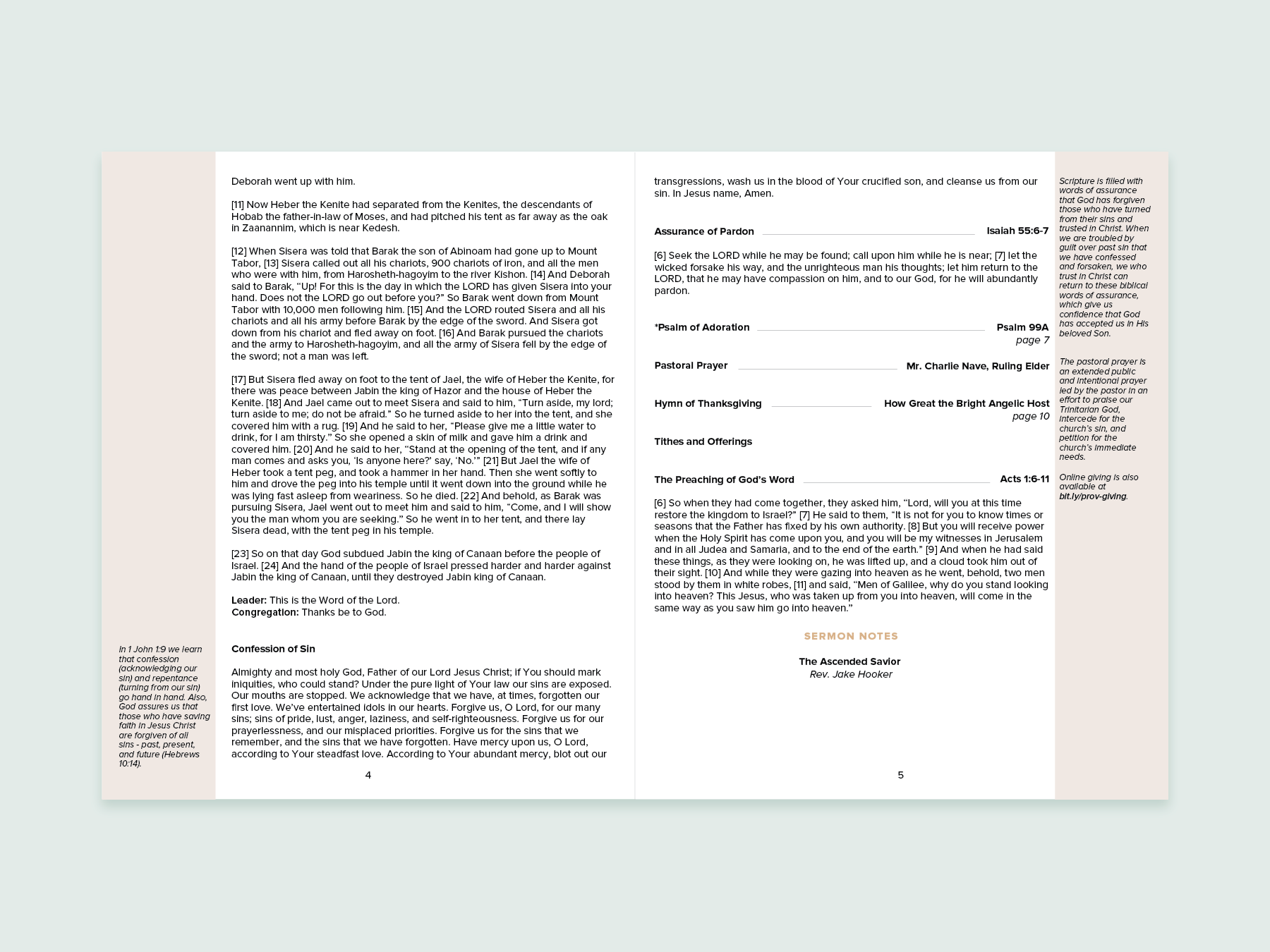
Which is exactly what the angels were getting at in verses 10-11. “And while they were gazing into heaven as he went, behold, two men stood by them in white robes, 11 and said, “Men of Galilee, why do you stand looking into heaven? This Jesus, who was taken up from you into heaven, will come in the same way as you saw him go into heaven.”
In other words, Jesus is going to come back in the same way he went up, but now, it’s time to get started proclaiming Christ as King to the world. The angels were not rebuking the disciples for longing to see Christ again. Surely every Christian should long for the return of the Lord. Rather, they were reminding them that there was work to be done before that glorious day arrived. Christ had given them a mission, the Holy Spirit was about to be poured out upon them, and the gospel was destined to spread from Jerusalem to the ends of the earth.
Where the disciples found themselves is exactly where we find ourselves still today.
We sit between Christ’s ascension and his return. Like the disciples we shouldn’t sit idly by. We actively wait. We proclaim the gospel. We make disciples. We pray. We worship. We bear witness to the risen and reigning King. We faithfully proclaim Christ as King to a world that desperately needs Him.
The book of Acts begins with Christ ascending into heaven. Humanly speaking, that almost seems backwards. If you were writing the story, would you let Jesus ascend into heaven or would you have kept him here? We hear all the statistics about more and more people walking away from the church. Don’t you think the church would be in a better place if Jesus would have remained on earth preaching, teaching, and healing in person?
And yet, Luke wants us to see something extraordinary. The greatest expansion of the kingdom of God in history doesn't begin while Jesus is physically walking the roads of Galilee. It begins after He ascends into heaven.
Why? Because Jesus never stopped working.
The ascension is not Christ's retirement. It is His coronation. He has taken His seat at the Father's right hand, where He now reigns over all things for the sake of His church. From His heavenly throne He pours out the Holy Spirit, builds His church, intercedes for His people, and advances His kingdom to the ends of the earth. That is why the church grows.
The church doesn't grow because we're clever. It doesn't grow because we have the most creative programs, the most gifted leaders, the best marketing strategy, or the most impressive buildings. Those things may have value, but they have never been the source of the church's power. The church grows because Christ reigns.
That ought to fill us with tremendous confidence. Providence Presbyterian Church is not ultimately dependent upon the wisdom of her elders, the gifts of her pastor, or the strength of her members. Our confidence rests in the risen, ascended, and reigning Christ. The same King who empowered the apostles, who sustained the early church through persecution, and who spread the gospel throughout the Roman Empire is the very same King who rules His church today.
And also means that you don’t have to live the Christian life in your own strength. You don't have to wonder whether Christ has abandoned His church or whether the darkness will somehow prevail. The King who sits at the Father's right hand has not forgotten His people. He is ruling over every circumstance of your life. He is interceding for you. He is giving His Spirit to strengthen you. And He is accomplishing His purposes, even when you cannot see what He is doing.
So whatever the Lord has called you to this week—whether it is raising your children, serving your family, loving your neighbors, sharing the gospel with a friend, or simply remaining faithful in the ordinary routines of life—remember that you do not labor alone.
Jesus is alive. He is reigning. He is building His church. And because that is true, we can move forward with confidence until the day our ascended King returns in glory.
