
In Matthew 15, Jesus famously said, “Hear and understand: it is not what goes into the mouth that defiles a person, but what comes out of the mouth; this defiles a person.”
If you remember that passage, you’ll recall that the disciples were confused by His statement. They had grown up in a religious system that focused so much on external rituals that the idea of internal defilement sounded foreign.



But Jesus clarified His meaning with unmistakable directness:
“Do you not see that whatever goes into the mouth passes into the stomach and is expelled? But what comes out of the mouth proceeds from the heart, and this defiles a person.”
And then He lists the evidence of a heart out of step with God: evil thoughts, murder, adultery, sexual immorality, theft, false witness, slander.
In other words, sin always begins in the heart long before it ever becomes visible in the life.
Most of us know that already. But what we often forget is the obvious implication: the primary battlefield of the Christian life is not your external behavior—it is the hidden places of your heart and mind. What fills your thoughts will eventually shape your words, your habits, and your character. What you meditate on today will become the kind of person you are a year from now.
That is precisely why Paul, in Philippians 4, doesn’t begin with techniques, programs, or quick fixes. He goes straight to the inner life of the believer. A strong and joyful Christian life grows as we guard our minds with God’s truth (v. 8), follow godly examples worth imitating (v. 9a), and walk daily with the God who gives peace (v. 9b).
Paul is showing us that lasting peace and lasting joy do not begin with what we do—they begin with what we think, what we love, and whom we trust.
Guard Your Mind With God’s Truth (v. 8)
Last week, we looked at the controversy between two ladies: Euodia and Syntche. They were feuding over something–Paul never shares the exact nature of their disagreement. But it really doesn’t matter, because it was a minor, petty, disagreement, which presents an entirely different set of challenges from church destroying theological controversies. There are some things that believers should be able to work out and then there are things that are worth breaking fellowship over. By the way, that’s not a limp wristed call to smooth every rough corner of Christianity because we don’t ever want to offend anyone.
That certainly doesn’t mean that we need to smooth over every rough corner of our Christian faith in order to minimize the potential for controversy, and yet at the same time, it should really go without saying that we shouldn’t spend all our time looking for points of conflict just to be disagreeable.
But here’s where Paul takes us next—and it’s a direction we might not expect after addressing a disagreement in the church. Instead of dissecting the argument and assigning blame, he turns our attention to something far deeper and far more formative: the inner life of the mind. Because the truth is, most conflicts—especially the petty ones—don’t begin “out there” in circumstances; they begin “in here,” in the thoughts we choose to dwell on, the assumptions we nurse, the narratives we rehearse, the motives we impute.
And this is why Paul pivots to the thought life of the believer. What fills your mind today will shape the kind of Christian you become tomorrow. Your thoughts are never neutral. They are always doing something to you. What you consistently think about will shape what you love, what you desire, what you fear, and ultimately what you do. If you dwell on slights, you will become suspicious. If you dwell on bitterness, you will become—hard, closed off, and quick to assume the worst.. If you dwell on fear, you will slowly withdraw from everything and everyone over time. But if your mind is saturated in what is true, honorable, just, pure, lovely, commendable—your life and relationships will begin to reflect that beauty and stability.
And so Paul knows that church unity is not maintained by rules but cultivated through rightly ordered thoughts. Which helps us understand why Paul says what he says in verse 8.
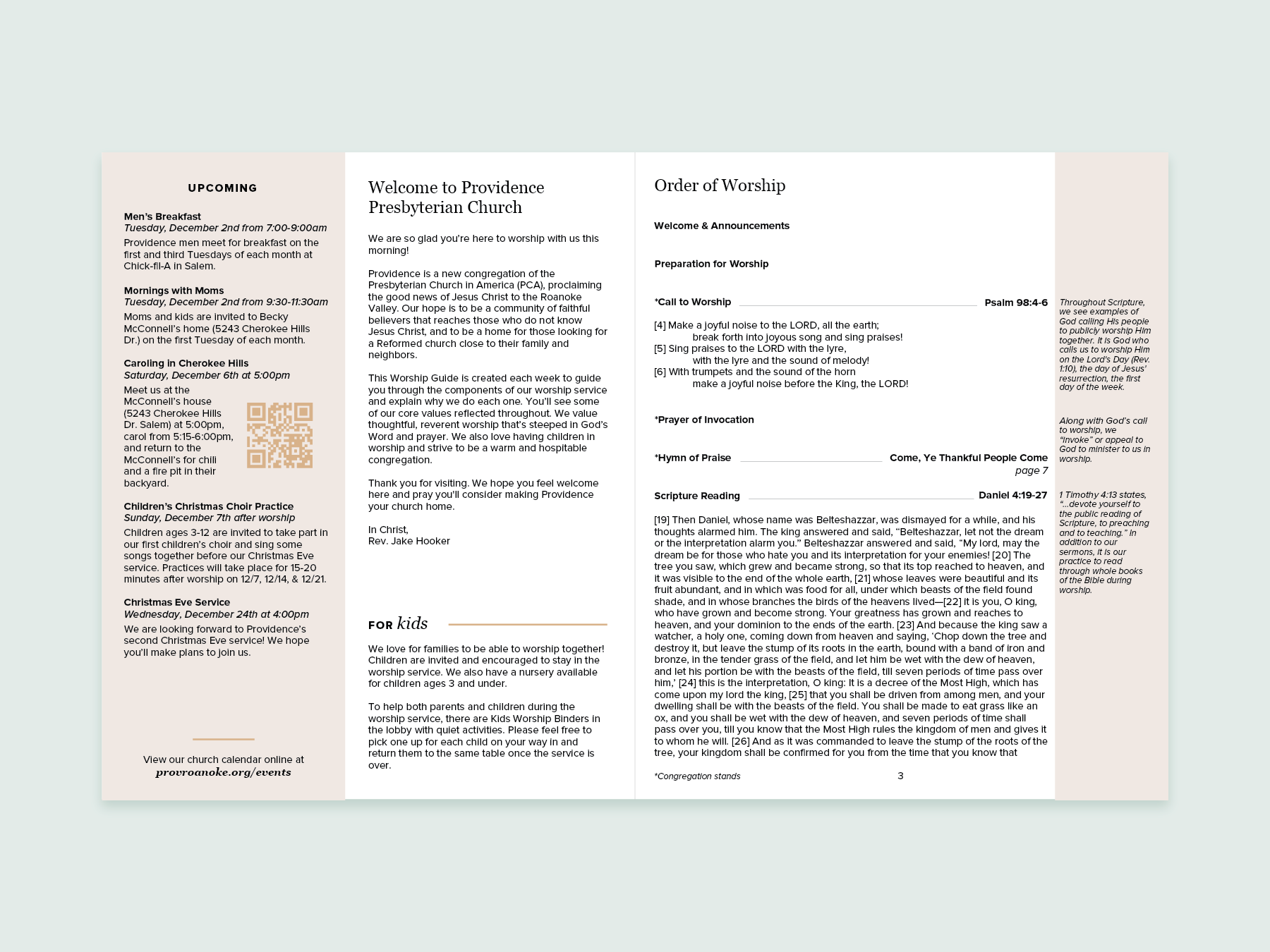
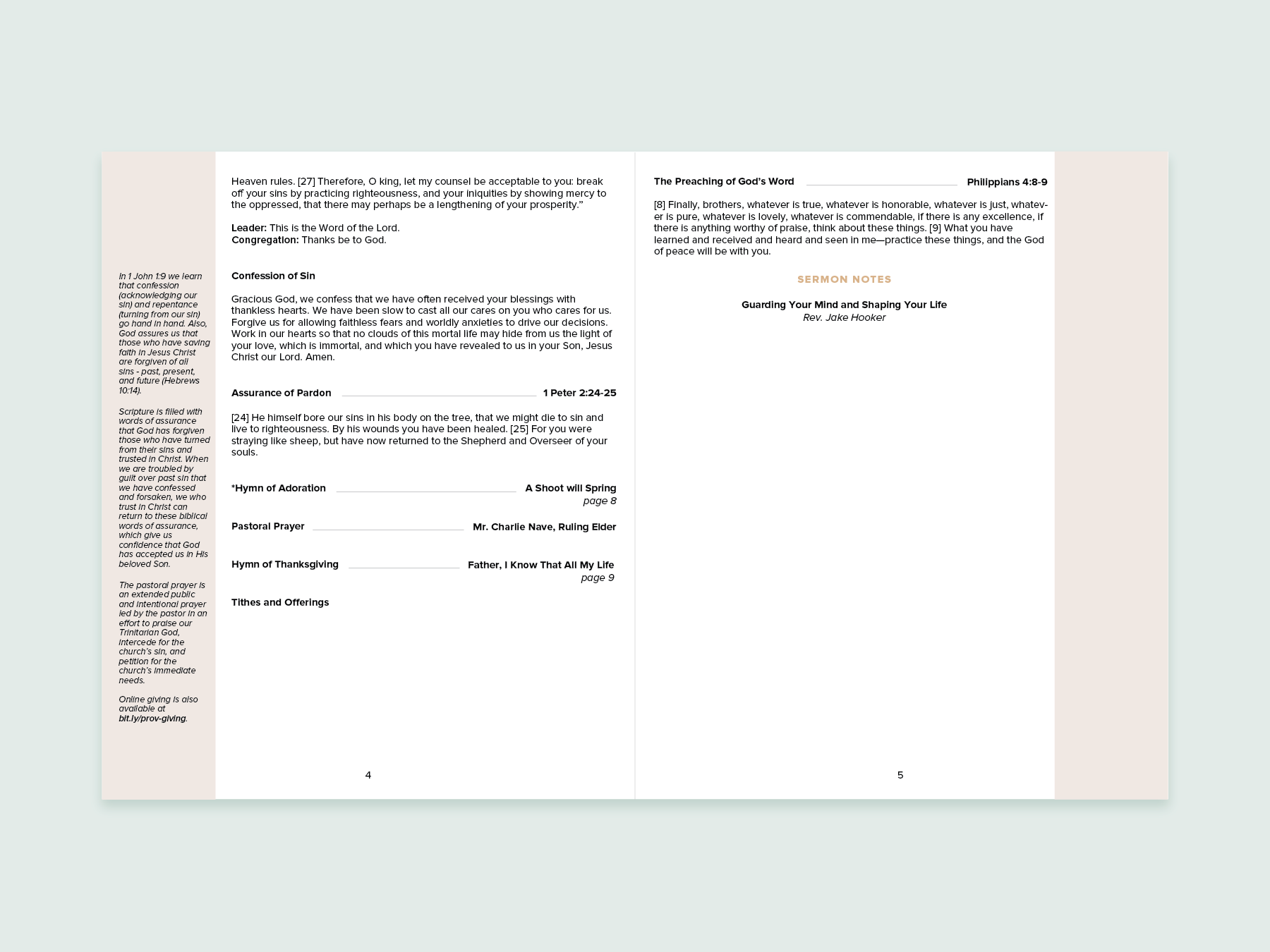
“Finally, brothers, whatever is true, whatever is honorable, whatever is just, whatever is pure, whatever is lovely, whatever is commendable, if there is any excellence, if there is anything worthy of praise, think about these things.”
Paul is talking about the Christian thought life, which is hopefully something that you’ve considered before. Throughout the history of the church, the importance of shaping the mind has gone through periods of heavy emphasis and periods of neglect. Some generations elevated the life of the mind as an incredibly central element to one’s walk with Christ.
This was a major point of emphasis for the Puritans. The Puritans were a group of 16th–17th century English Reformed Protestants who sought to “purify” the Church of England from remaining Roman Catholic practices and to model a thoroughly biblical, disciplined Christian life. A lot of them fled England and ended up in the Massachusetts Bay colony.
But one of the major subjects of their writings was reflecting on their own spiritual walk.
For example in Thomas Brooks’ work, Precious Remedies against Satan’s Devices, in discussing Satan’s devices to keep saints in a sad, doubting, questioning, and uncomfortable condition, he wrote,
“The first device that Satan has to keep souls in a sad, doubting, and questioning condition, and so making their life a hell, is, By causing them to be still poring and musing upon sin, to mind their sins more than their Savior; yes, so to mind their sins as to forget, yes, to neglect their Savior; that, as the Psalmist speaks, 'The Lord is not in all their thoughts' (Psalm 10:4). Their eyes are so fixed upon their disease, that they cannot see the remedy, though it be near; and they do so muse upon their debts, that they have neither mind nor heart to think of their Surety. A Christian should wear Christ in his bosom as a flower of delight, for he is a whole paradise of delight. He who minds not Christ more than his sin, can never be thankful and fruitful as he should (142).”
He’s exactly right, isn’t he? If you spend too much time thinking about sin you’ll stop thinking about the Lord. And really, this is one example among many. The Puritans on the whole were very focused on how your thought life impacted your pursuit of holiness.
Which is actually a criticism of the Puritans some will level against them from time to time. Rather doing things for the Lord, they instead spent their time thinking about themselves and their own hearts.
I think it’s a fair critique, however, it seems to me that we have the opposite problem today. If the Puritans were too far on one end of the spectrum, perhaps we’ve gone too far in the other direction. We rarely spend time thinking about our own spiritual condition. Do you spend any time at all thinking about your relationship with God or do other things occupy the most space in your minds?
Which is why Paul says what he says in verse 8. The battlefield for your personal holiness begins in your mind. Notice that Paul uses the word whatever six times and any twice. The reason for that is that this list is broadly good things that should occupy our thought life—not an exhaustive or exclusive list. It’s not like he expects the believers in Philippi to only think about what he’s listed here.
But nevertheless, the eight things he lists in verse 8 are a great starting place, which is why we’re going to spend some time looking at each one individually. Not surprisingly, Paul begins with, whatever is true.
By whatever is true Paul has something closer in mind to what he says in Ephesians 4:25, “Therefore, having put away falsehood, let each one of you speak the truth with his neighbor, for we are members one of another.” The idea here is that truth stands in opposition to falsehood and lies. So, Paul isn’t necessarily making an explicit reference to Scripture. No doubt, it isn’t less than Scripture, because Scripture is the foundation of all truth. In fact, the rest of this list really flows out from truth. In order to know what is honorable, just, pure, lovely, commendable, and praiseworthy you have to first know what is true.
Meditating on whatever is true means deliberately setting your mind on reality as God defines it, not as the world distorts it. It means training your heart to love what is real, solid, trustworthy, and aligned with the character of God. Truth becomes the lens through which you evaluate every thought, every desire, every opinion, and every claim that comes your way. And that’s essential, because we live in a world overflowing with lies—lies about who God is, who you are, what matters most, and what will bring you joy. If your mind is not anchored in what is true, you won’t be interested in what is false.
The second item on Paul’s list is whatever is honorable. One commentator wrote, “In his speech and in his entire behavior believers should be dignified, serious. Proper motives, manners, and morals are very important. In an environment then as now characterized by frivolity whatever things are honorable surely merit earnest consideration.” In other words, Christians are called to cultivate a mindset that resists the pull of the trivial, the crude, and the flippant. To dwell on what is honorable is to fill the mind with things that elevate rather than cheapen the soul. It means esteeming what carries weight and moral gravity—what reflects the character of God and inspires reverence in those who see it lived out.
The third item is whatever is just. Paul isn’t referring to the hijacked, modern version of justice that treats people differently based on group identity or social status. That is certainly not the justice Paul has in mind. Instead, he calls Christians to deal fairly and rightly with everyone around them. Fairness and integrity in our dealings should be a given, especially when we remember that we’re called to “be holy as God is holy.” His perfect standard of justice, uprightness, and righteousness is what every Christian is called to. And so, to pursue what is just is to live in a way that mirrors God’s fairness and righteousness in a fallen world.
Next Paul says whatever is pure. This would have been an important one for the Philippians since everything around them, including what was being taught by false teachers was impure and unchaste. Which is also true for the world that we live in today. Our society is highly unchaste, impure, graphic, and increasingly comfortable celebrating what God calls shameful.
Impurity in every sense is being constantly thrown in our face, nevermind, the accessibility to the destructive forces of pornography. You and I need to do whatever it takes to fight for purity. Get a dumb phone, lose the internet, burn the smut book, stop fantasizing about what your life might have looked like if you were married to someone else. “If your right eye causes you to sin, tear it out and throw it away. For it is better that you lose one of your members than that your whole body be thrown into hell.” We need to be willing to take drastic measures in order to fight for our purity, because that’s what God calls us to, and the first step in all of this, is to set your mind upon whatever is pure.
Whatever is lovely. Interestingly, this is the only place in the entire New Testament that this particular word is used. As Strong’s Concordance notes, “this quality draws the mind toward what evokes affection, delight, and moral beauty.” In other words, Paul is calling us to dwell on things that inspire admiration and joy—things that cultivate a sense of wonder, gratitude, and appreciation. Those things that will make us feel and evoke love.
Whatever is commendable. Here Paul is talking about those things that are laudable, reputable, and admirable. He’s talking about those things where when people learn about them, they want to say, “good job!”
If there is any excellence. Too many Christians settle for mediocrity, whether that’s in their spiritual life, domestic life, and even work life. We’re content doing the bare minimum, whatever it takes to scrape by. But Paul calls believers to pursue what is truly excellent—morally, spiritually, and practically.
If there is anything worthy of praise. By this I think he’s referring to conduct that will win the admiration and support of those around you—actions that clearly reflect God’s character, demonstrate integrity, and shine as a compelling witness to the watching world.
Hopefully, you can see exactly why Paul would encourage the Philippians to think on these things. Because whatever captures your attention will eventually capture your affection.
If you feast your mind on the world’s values—materialism, comfort at all costs, sexual impurity, constant distraction—those things will become increasingly desirable. But the opposite is also true: the more you dwell on what is true, honorable, just, pure, lovely, and commendable, the more your heart will hunger for the things of God.
There’s another aspect to these eight things that is overlooked: It’s obviously true that the Bible doesn’t address every situation you and I face in life, which means that from time to time we might find ourselves in a “gray area.” That is, a space where the God-honoring course of action isn’t abundantly clear. Well this verse gives us a grid for evaluating those situations: Does it support whatever is “true, honorable, just, pure, lovely, commendable, excellent, and praiseworthy?”
What you meditate on today will shape the kind of person you become tomorrow.
Follow Godly examples (v. 9a)
But Paul doesn’t tell us to think about these things and leave us on our own to figure it out. Paul also tells us that we need to follow Godly examples, which is exactly what he says at the beginning of verse 9, “What you have learned and received and heard and seen in me—practice these things…”
We all need examples of people who, to the best of their ability, try to pursue what is true, honorable, just, pure, lovely, commendable, excellent, and praiseworthy. We all need to be pursuing these things, but we especially need older men and women to set the example.
We live in a world where fewer and fewer young people have stable or healthy father or even mother figures in their lives, and so the need for godly examples becomes even more urgent. I’m not talking about people out there in the world, I’m talking about people right here in this room.
So many young Christians are growing up without consistent guidance, without someone to show them what maturity looks like. And when that foundation is missing, we shouldn’t be surprised when young people turn to places like the internet to find advice. They’re looking for role models and they’re not always finding the right ones.
This is why the church needs older men and women to step into those gaps. Older couples: when was the last time you invited a young family over for dinner? When was the last time you said, “You know, we struggled with x, y, or z too and here’s how we handled it”? Sometimes the most powerful discipleship doesn’t happen in a classroom but in casual conversation across the kitchen table.
So much of the Christian life is caught rather than taught. Watching others faithfully live out their faith is tremendously important. Which, as a side note is why it’s so important for children to be in the service with us.
They need to see Dad and Mom—and the entire church body—taking the worship of God seriously. They need to watch the people they love standing, singing, praying, confessing, and humbling themselves before the Lord. How many of us here were shaped by a godly father, mother, or grandparent who made us go to church whether we wanted to or not? That faithful example will shape them far more deeply than we often realize.
We need examples. We need to see what it means to love, serve, and repent. Sometimes the most powerful lesson in forgiveness is watching someone else offer it. and preserve. The church needs to be a place where we’re all striving to be a godly man or woman for someone else to emulate.
Experience Daily Communion With the God of Peace (v. 9b)
But notice what Paul says at the end of verse 9: “…and the God of peace will be with you.”
He doesn’t simply say, “you’ll feel peace.” He’s not talking about a feeling. He’s talking about the Lord himself. He will be your peace.
You experience God’s peace when your mind is shaped by truth and your life is shaped by obedience. Peace comes after thinking and living rightly. Which is frankly so different from what you’d expect! We seem to easily fall for the same lie over and over again that we’ll find peace and contentment through distractions and worldly pleasures. But they never satisfy, do they?
The peace we desperately long for is found in our commitment to pursuing those things Paul commends: whatever is true, honorable, just, pure, lovely, commendable, excellent, and praiseworthy. If we allow those things to shape our minds, they will inevitably shape the way we live our lives. The more we submit our lives to Christ, the more peace we’ll experience.
Paul is not simply giving us a list to follow in order to find peace. He’s not saying that peace is found in a perfectly disciplined thought life or well-ordered schedule. Paul is leading us back to a person, because it’s only in the presence of Christ you and I can ever experience peace in the midst of the storms of life.
That’s why Paul ends by saying, “Practice these things, and the God of peace will be with you.” The promise is not merely that you’ll feel better, worry less, or become more stable emotionally—though those things often follow. The promise is that the Lord Himself will be near.
This means your pursuit of right thinking and right living is not an act of self-improvement; it’s an act of communion. Every time you turn your mind toward what is true, every time you choose what is honorable, every time you refuse impurity and pursue what is lovely, every time you imitate the godly examples God has placed in your life—you are, in a real sense, stepping further into the presence of the God who gives peace.
And that is the great encouragement of this passage: peace is not fragile, because God is not fragile. Peace is not fleeting, because God is not fleeting. The God of peace goes with you into every anxious moment, every difficult conversation, every sleepless night, and every storm you will ever face.
And when the God of peace is with you, you lack nothing. Amen. Let’s pray together.
