
This morning we’re beginning our advent series that I’m calling The Songs of Christmas. When you study God’s Word, you quickly realize that there are a lot of songs that are centered around the birth of Jesus Christ.
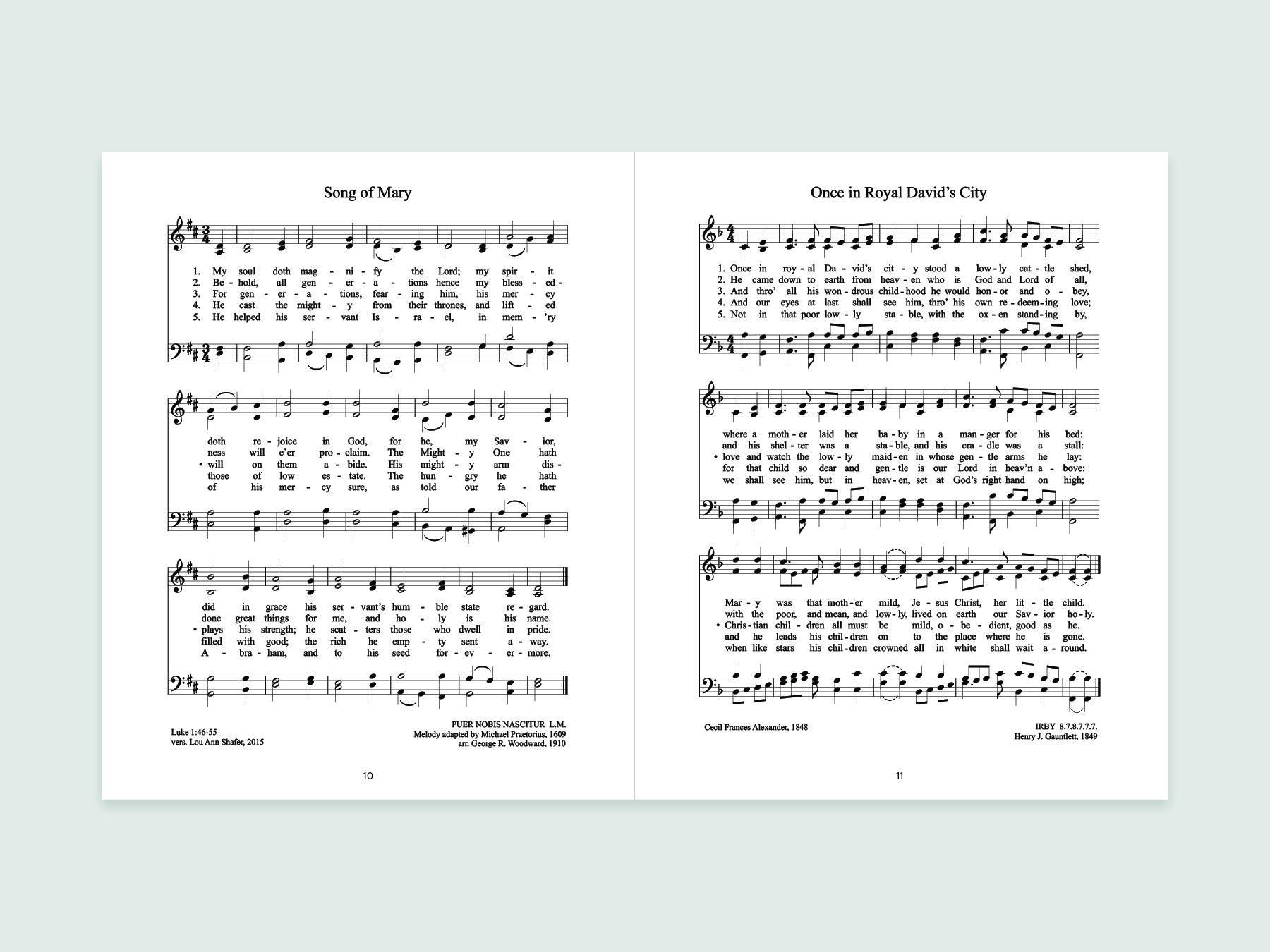
And so this morning we’ll look at Mary’s Song, next week we’ll look at Zechariah’s prophecy, the following week we’ll look at the Angels’ Song, and lastly, on Christmas Eve we’ll look at Simeon’s Song. Each one of these prophetic songs speak to the anticipation of the messianic reign of Jesus Christ breaking through.
In many ways, it reminds me of a five-year-old waking up on Christmas morning. The barely contained excitement that fills an entire house well before the sun even rises. In that moment there is such beauty and simplicity, which reminds even us adults what it’s like to look forward to something with our whole heart.
And I think that really captures the Christmas season. Because the Jewish people had long anticipated a messianic deliverer. When will he come? What will he be like? How would he deliver his people?
For centuries those questions had gone unanswered—until an angel appeared to Mary and Joseph. And of course, Mary couldn’t possibly understand everything that the coming of this Jesus, the promised Messianic Deliverer, would involve. How could she? All she knew was that God had spoken, His promise was being fulfilled, and the news she received was nothing short of glorious.
Obviously, the angel had told Mary that she would carry, deliver, and be Jesus’ earthly mother despite being a virgin. But Mary’s song of praise isn’t in response to the angel, it’s in response to what her close relative, Elizabeth and what she said to her. Elizabeth said to Mary, “Blessed are you among women, and blessed is the fruit of your womb! 43 And why is this granted to me that the mother of my Lord should come to me?”
And so, Mary’s song is in response to what Elizabeth said to her.
If you’re looking at this passage in the ESV then you probably noticed the header above the passage reads, “Mary's Song of Praise: The Magnificat.” Historically, this passage has been simply called the Magnificat which is Latin for, “My soul magnifies or proclaims the greatness of the Lord.”
Because Mary’s response to what Elizabeth says to her is to praise and magnify the Lord. Which is an amazing response, right? You’d expect Mary to be consumed by the fact that God has assigned her to birth and raise the Messiah, which would have been one of the most humbling tasks ever. No doubt, Mary understands that, but it’s not the thing that has captured her heart and mind. What captured Mary’s heart and mind was God’s goodness and faithfulness.
And so what I want us to see this morning is how Mary’s Song looks at God’s past (vv. 46-49), present (vv. 50-53), and future faithfulness (vv. 54-55).
God’s Past Faithfulness (vv. 46–49)
Notice how Mary begins her song. She says,
“My soul magnifies the Lord, 47 and my spirit rejoices in God my Savior, 48 for he has looked on the humble estate of his servant. For behold, from now on all generations will call me blessed…”
As I was saying earlier, Mary hears Elizabeth call that baby in her belly her Lord. And so, Mary’s response was to simply sing praises to the Lord. After all, she was assigned one of the most humbling tasks ever—she was responsible for carrying, delivering, and raising Jesus Christ. And obviously, Mary understood what an incredible task that was.
But notice how Mary rejoices. She doesn’t say, thank you Lord, because everyone around me needs to be saved. No, in verse 47 she rejoices in “God [her] Savior.” Prophecies throughout the Old Testament spoke of the coming deliverer who would save God’s people. And of course, salvation throughout God’s Word could be a reference to physical or political salvation. In fact, the common understanding among the Jewish people was that the Messiah would be some sort of political revolutionary who would free the Jewish people from their Roman captors.
But Mary understood that the Messiah was going to do something greater than deliver his people from political captivity. She recognized that there was a spiritual component to all of this. She recognized that Jesus was going to deliver his people from spiritual captivity. Which would explain why God as a Savior would have been personal for Mary.
My point is Mary understood that spiritual deliverance, salvation, wasn’t just something for everyone else. She understood that whatever Jesus was going to do, she needed it. She didn’t know the cross would be in Jesus’ future, but she didn’t need to—she just knew that she needed Jesus.
And so when she says God has looked upon her “humble estate,” she’s not bragging about being chosen — she’s confessing her unworthiness. She didn’t come from nobility. She wasn’t anything special, and yet, the child in her womb is not simply Israel’s deliverer, but her deliverer as well.
Everything in Israel’s history, and everything in Mary’s life has been building to this particular moment. And so Mary can look back on her past and say, “He who is mighty has done great things for me.” God had been working behind the scenes preparing Mary and the entire world for the moment Jesus would come to earth.
Mary’s song isn’t saturated with pride, entitlement, or a sense that she somehow earned her place in redemptive history. Instead, she marvels that God would look upon her—someone so ordinary, so small, so insignificant and undeserving as she was. In her own words, she was of “humble estate”—not socially impressive, not politically significant, and certainly not spiritually superior. Mary’s heart is full of gratitude and thankfulness, because she can see God’s hand at work throughout her life.
So when she says, “He who is mighty has done great things for me,” she is looking back over a lifetime of grace—grace that prepared her for this moment, sustained her faith, and assured her that the God who had always been faithful would remain faithful still.
More often than not, time gives you perspective. The longer you live, the more you can see God’s hand at work in your life. You can trace His faithfulness to you in the ups and the downs. And what we all have to keep in mind is that God never intends to leave you where you are. He intends to grow, sanctify, and shape you more and more into the image of His Son. That means every season—whether joyful, confusing, painful, or ordinary—is part of His refining work.
Sometimes that sanctifying work feels slow. Sometimes it feels hidden. Sometimes it feels like He’s undoing you before He rebuilds you. But He is always moving you toward Christlikeness. He uses trials to deepen your dependence, blessings to stir your gratitude, waiting to strengthen your hope, and His Word to anchor your soul. Nothing is wasted. Nothing is random. Nothing is outside His purpose.
Mary understood this. Her life was suddenly turned upside down, yet she trusted that God was not just working around her—He was working in her. And the same is true for us. God’s faithfulness in the past encourages us in the present, and His work in the present prepares us for the future He is shaping. He is not finished with you yet.
God’s Present Faithfulness (vv. 50–53)
God’s faithfulness certainly isn’t limited to the past. How discouraging would it be if that’s where it all ended? We can certainly see God’s faithfulness here in the present as well. Praise God, His mercy, grace, goodness, and faithfulness are still at work today.
Which is exactly what Mary said in verse 50: “And his mercy is for those who fear him from generation to generation.”
Isn’t it such wonderful news that God’s past mercy isn’t a museum we visit from time to time; no it’s a spring that never stops flowing. It continues from generation to generation. That means that God’s mercy didn’t dry up in Mary’s day. It didn’t expire after the apostles. It didn’t weaken during the Middle Ages or lose power in the modern world. It’s active. It’s present. It’s available right now in your life and mine. God is faithful and active in the here and now. He’s still keeping His promises. And He’s not done yet.
Which is what the Christmas season is all about! The birth of Jesus Christ is the ultimate sign that our God is a covenant-keeping, faithful, true to His Word God. He doesn’t abandon His people.
And one of the clearest ways that we see God at work is how he consistently opposes the proud and gives grace to the humble.
Notice what Mary sings about in verse 51: “…He has scattered the proud in the thoughts of their hearts; 52 he has brought down the mighty from their thrones and exalted those of humble estate; 53 he has filled the hungry with good things, and the rich he has sent away empty.”
In many ways it reminds me of various Psalms. How many Psalms start out by praising God and then at some point turn to rain down your justice upon those who hate you—or something along those lines. And that’s because one of the clearest ways we see God’s hand at work is in the way he reverses worldly values. The Lord will, as Mary says, scatter the proud, he’ll strip them from their thrones, and at the same time, he’ll lift up the humble, give food to the hungry and send the greedy away empty-handed. God is going to break down, destroy, reverse, reorder, worldly values.
If you’re anything like me, you read that and then look at the world around you and feel discouraged. Because when you look at the world around us, it really does seem as if evil, corruption, and sin are not only flourishing but are oftentimes celebrated. On the other hand, things that please God—what is true, honorable, just, pure, lovely, commendable, excellent, praiseworthy, seem to be dismissed, ignored, or ridiculed and mocked.
But God’s Word is clear—He’s going to set things straight. What looks like unchecked wickedness is not a sign of God’s absence, but a stage for His future justice. Every act of corruption that seems to “get away with it” is already under His scrutiny.
Every distortion of truth, every celebration of sin, every mockery of righteousness is noticed by the One who sees perfectly and judges righteously. Scripture never promises that evil will flourish forever—it promises the opposite. God will dismantle it. He will reverse the world’s values. He will bring down the proud, expose the corrupt, and vindicate His people. Evil might look loud right now, but its days are numbered.
Even though it may seem as if the world or even pain and sorrow have the upper hand in your life—God has given you and I a glimmer of hope. A down-payment on His promises in Jesus Christ. Because Jesus proves that God is going to make good on His Word.
Just think about what Jesus meant for Mary: No longer would people have to wonder if God had remembered them and His Messianic promises of deliverance because there would be flesh and blood to look at. The invisible God was making Himself visible. The promises that once felt distant and vague were now kicking inside Mary’s own womb. The God who seemed silent for four hundred years was now speaking through a baby’s cry.
That’s how God works. He often starts with a whisper, not a shout. A seed, not a tree. A baby, not a warrior. A glimmer, not the full sunrise. But that glimmer is enough to anchor the soul. It’s enough to remind us that darkness does not get the last word, that silence does not mean absence, and that waiting is not wasted. The humble, the meek, and the suffering would not be forgotten or ignored.
And it serves as a reminder that even when things seem so discouraging all around us, God is active here and now. His mercy is still for those who fear him from generation to generation.
Because here’s the truth that you and I often forget: God can change things quickly. One minute things look hopeless and then at the last minute he'll suddenly intervene in ways we never expected. One moment the situation seems impossible, and the next, He turns it completely around—lifting the lowly, providing for the needy, and confounding the proud. What feels hopeless and discouraging to us right now is not beyond His control.
God’s Future faithfulness (vv. 54–55)
But of course God’s faithfulness isn’t limited to the past or the present. It extends into the future as well.
In verses 54-55 she sings, “He has helped his servant Israel, in remembrance of his mercy, 55 as he spoke to our fathers, to Abraham and to his offspring forever.”
You might read that and think, “Jake… Mary is referring to all those times in the Old Testament where God delivered the people of Israel. She’s making a clear reference to the past.” And of course, that is absolutely true. Mary is referring to the past—how the Lord helped Israel, how He remembered His mercy, how He spoke to their fathers—to shed light on what the Lord will do in the future. Notice what she says there at the end of verse 55? She says “he spoke to our fathers, to Abraham and to his offspring forever.”
In other words, the mercy God displayed toward Abraham, Isaac, Jacob, and the nation of Israel wasn’t a one-time act. It wasn’t limited to a single generation. It wasn’t locked away in the pages of history. It was an ongoing promise—an everlasting promise that God Himself intends to carry forward into eternity.
The fact that Mary says his promise is to the offspring of Abraham forever is significant because of what Paul says in Galatians 3:7. “Know then that it is those of faith who are the children of Abraham.” The offspring of Abraham are those who have put their faith and trust in Jesus Christ. This isn’t some sort of exclusive promise to the people of Israel, because Paul makes it abundantly clear who the true children of Abraham are those who have put their faith in Jesus Christ.
But again, Mary didn’t understand the birth of Jesus as some broad, generic promise. She understood that if God was faithful to Abraham, then God would be faithful to her. And if He was faithful to her, then He would be faithful to every generation that came after her—including yours and mine.
That’s the logic of covenant mercy. That’s the trajectory of Advent hope. God’s past actions guarantee His future ones. The God who acted then will act again. The God who kept His promises then will keep His promises to us now. And the God who brought Christ into the world the first time will certainly bring Him into our world again.
But life has a way of bogging us down. It’s easy to get discouraged when we dwell on the sins, mistakes, and struggles of our past. If we’re not careful, we can find ourselves living in an endless feedback loop of pain. I’m not saying there isn’t a time and a place for reflection, because there is. We should think about our personal holiness and how we can put the sins of the flesh to death, rather, what I’m saying is we shouldn’t perpetually live in the past.
Think about everything that the people of Israel had gone through. There had been 400 years of silence, but not only that—there were wars and captivity and pain and suffering.
Even Mary’s personal life was probably hard. We don’t really know much about her life before Jesus, but I think it’s safe to assume that simply living life in the first century was tough.
And yet, Mary doesn’t say, “well God, we've been waiting a long time, and frankly, it’s about time you did something.” Her magnificat wasn’t a sad song where she aired all her frustrations with the world she lived, along with all her personal grievances.
Mary’s magnificat is all about magnifying the name of the Lord for what He has done, what He is doing, and what He will do, despite everything that was going on all around her.
Because at some point you have to lift your eyes off of yourself in order to see the beautiful sunlight peaking over the horizon. God’s faithfulness in every age of history, in every season of life, is a promise, that what we look forward to in the future is going to be infinitely better than the things that we’ve experienced in the past. And the sign that we have for that is Jesus Christ.
If your sins have been forgiven through Jesus—which is, frankly, the most glorious news of all time—then that forgiveness is only a small glimpse of what’s still ahead. And that’s really my point: you and I should share Mary’s excitement, optimism, and confident hope for the future.
Not because the government will eventually get things right, or because society will suddenly become the community we’ve always longed for—our hope doesn’t rest there. We have real, lasting hope because Jesus Himself is going to do something about the brokenness of this world. He will set things right. He will heal what is shattered. He will finish what He started. He is the One who will make all things new, and for the Christian, that means the best is always yet to come.
Amen. Let’s pray together.
