
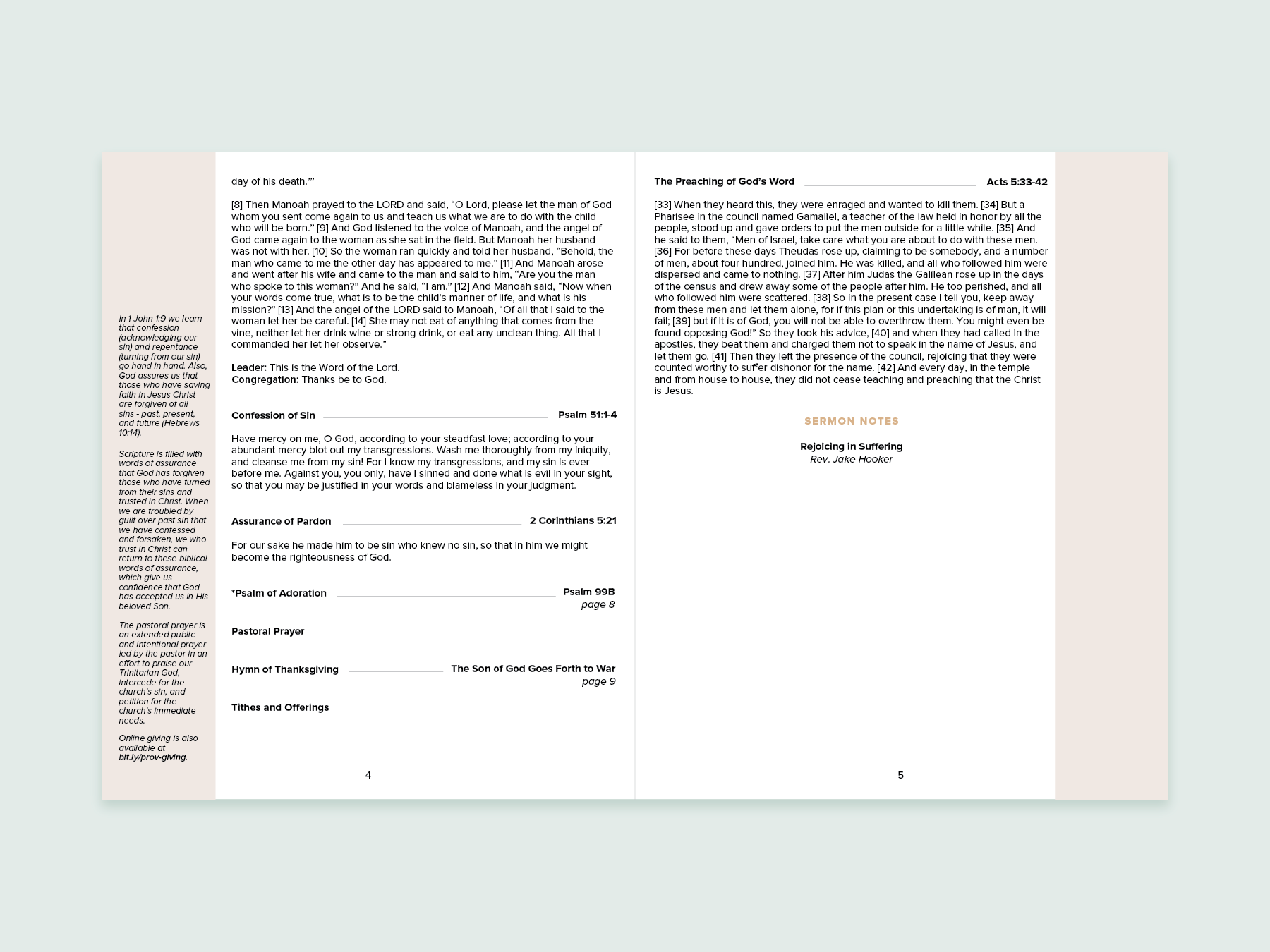
Rejoicing in Suffering - Acts 5:33-42
One of the hardest things about the Christian life is learning how to think about suffering. We know that Jesus Christ has conquered sin and death. We know that he has promised to preserve his people and bring them safely into his heavenly kingdom. And yet, when we find ourselves in the middle of pain, sorrow, and opposition.
And then Paul says in Romans, that, “we rejoice in our sufferings, knowing that suffering produces endurance, and endurance produces character, and character produces hope, and hope does not put us to shame, because God's love has been poured into our hearts through the Holy Spirit who has been given to us.






Or 1 Peter says, “But rejoice insofar as you share Christ's sufferings, that you may also rejoice and be glad when his glory is revealed.”
Jesus says something similar in Matthew: “Blessed are those who are persecuted for righteousness' sake, for theirs is the kingdom of heaven. Blessed are you when others revile you and persecute you and utter all kinds of evil against you falsely on my account. Rejoice and be glad, for your reward is great in heaven…”
The idea of rejoicing in suffering is a common Biblical idea, one that I’m sure isn’t entirely new to many of you. But how do you rejoice when following Jesus costs you a friendship? How can anyone rejoice while in the midst of depression or facing a serious diagnosis? How can you possibly celebrate feeling consistently disrespected because of your faith in Christ?
Because that’s precisely what we see in Acts 5:33-42. The apostles, after being arrested and threatened were then beaten for proclaiming the gospel. And we learn in verse 41 that after being beaten they rejoice. How is that possible?
What Acts 5 reminds us that the Lord uses suffering to strengthen your faith in Christ - and that is something to rejoice in. We’re reminded to expect three things: first expect opposition (vv. 33–39). Second, expect a cost (v. 40). Lastly, expect to rejoice (vv. 41-42).
If you recall earlier in Acts 5, the Sanhedrin had arrested and imprisoned the apostles for preaching Christ and proclaiming his resurrection. But during the night, an angel of the Lord opened the prison doors, brought them out, and commanded them to return to the temple and continue proclaiming the words of this Life. And that’s exactly what they did! By daybreak, they were right back in the temple teaching the people.
Well, when the Sanhedrin discovered what had happened, they had the apostles brought before them and demanded to know why they had continued preaching in direct defiance of their orders. And Peter and the apostles famously responded in verse 29, “We must obey God rather than men.”
In other words, they weren’t going to allow threats, intimidation, or even imprisonment to keep them from obeying the Lord Jesus Christ. They understood that their ultimate allegiance belonged to God, and they were determined to remain faithful to the calling he had given them.
And that brings us to our passage this morning. We pick up with an angry, frustrated, and jealous Sanhedrin. These men are furious that the apostles have continued preaching, and now they’re faced with a decision: What are they going to do with these men who refuse to be silenced?
Expect opposition (vv. 33–39)
The Sanhedrin, the Jewish council of 71 elders, chief priests including the High Priest, Scribes and teachers of the law which of course included the two major parties: the Pharisees and the Sadducees.
If you’ve studied the Scriptures then you know that the Pharisees and Sadducees did not get along, however, they could agree on one thing—their total disdain and hatred of those who proclaimed the name of Jesus Christ.
Which is exactly what we’re told in verse 33. When they heard that the Apostles had no intention to cease from talking about Jesus, we’re told that “they were enraged and wanted to kill them.”
Normally, we think of the gospel as bringing peace, which of course it does! It does bring peace! It reconciles sinners with a holy God. But it’s also true that the gospel confronts those living in rebellion against God.
I had a friend who basically told me at one point that he had no interest in turning his life over to Christ because he knew that Christ would require his life to change. And he wasn’t interested in that at all. He didn’t want his life to change. He wanted to remain in the sin that he enjoyed.
Which I feel is true for a lot of people. They prefer a life apart from Christ because they don’t want to change. Their sin has hardened their heart.
And it’s really interesting because the sin that the Sanhedrin and Jewish religious elites loved so much was power and authority. The thing that Christ would require of them is to let go of their power and authority and bow their knee to Him—and they didn’t want to do it.
It’s what Isaac Watts penned in that famous hymn of his When I Survey the Wondrous Cross. Most of you probably know the lyrics: Love so amazing, so divine, demands my soul, my life, my all.
Jesus doesn’t ask for just a piece of your life, he demands it all. For many people that demand is offensive because it’s too high.
The Sanhedrin hated the gospel, they hated that the apostles were becoming more influential which meant they wanted them dead. Yet Gamaliel gives some helpful advice. Gamaliel was an influential Pharisee and might be familiar to some of you as the Pharisee that the Apostle Paul sat under.
But here, Gamaliel’s advice reflects God’s common grace. Common grace is the goodness God shows to all people, believers and unbelievers alike. Scripture tells us that God causes it to rain on the just and unjust. In a similar way, we all know that there are unbelievers who are wise, knowledgeable, and committed to restraining evil. This is God’s common grace.
Just as a broken clock can be right twice a day, unbelievers can at times, offer wise, helpful, and beneficial insights. And yet at the same time, we must remember that because someone says something that is true, good, or beneficial doesn’t mean they’re trusting in Christ, which is how I think we’re to understand Gamaliel’s counsel.
Gamaliel reminds the Sanhedrin of other Jewish leaders who had risen up in the past, including Theudas and Judas the Galilean (not to be confused with Judas Iscariot, the man who betrayed Jesus!). Both men had attracted followers and led movements that eventually fell apart. Once their leaders were gone, their followers scattered, and their movements faded away. Gamaliel points to these examples to make a simple argument: human movements may generate a great deal of excitement and attract a large following, but if they are merely the work of men, they will ultimately come to nothing.
But then he makes an amazing statement in verse 39: “But if it is of God, you will not be able to overthrow them. You might even be found opposing God!”
In other words, if the apostles’ work is merely of human origin, it will eventually fail, but if it’s from God it cannot fail. And, of course, that’s true! God’s purposes cannot be frustrated or overthrown by human opposition.
That’s one of the central themes of the book of Jonah. God commands Jonah to go and preach to Nineveh, and Jonah essentially says, “No, thank you!” He heads in the opposite direction, attempting to flee from the very God who commissioned him. Jonah doesn’t want to do what God has commanded him to do, so he tries to run from God’s purposes. And we all know how that turned out! Jonah could resist God’s command, but he could not ultimately thwart God’s purposes.
That’s why it’s so important for us to remember that God’s purposes are not dependent upon favorable circumstances. His plans are not thwarted by opposition, setbacks, or even suffering. As Christians, our confidence doesn’t rest in the conditions around us, but in the sovereignty of the God who rules over them.
Because if we’re honest, there can be a real temptation to soften the gospel message based on how we think it will be received. We certainly see this among pastors, but we’ve all had moments where we’ve shrunk back from speaking the truth because we knew we were in a hostile environment.
We want to be well received. When we speak up we want people to respond positively, we don’t want to be met with hard opposition. And yet, if we’re not careful, we can begin to measure the faithfulness of the church by the response we receive.
We can fall into the trap of thinking that a poor reception must mean we’ve presented the gospel poorly, while a positive reception must mean we’ve presented it well.
But that’s not necessarily the case. Acts 5 reminds us that the gospel can be faithfully proclaimed and still be met with fierce opposition. The apostles preached the truth, and the response was so hostile that the council wanted to put them to death!
So here’s the question I want to put before you this morning: if the gospel doesn’t elicit the response we desired does that mean it’s failed? The answer is no.
Jesus said that he would divide people even within their own family. “Do not think that I have come to bring peace to the earth. I have not come to bring peace, but a sword. For I have come to set a man against his father, and a daughter against her mother, and a daughter-in-law against her mother-in-law. And a person's enemies will be those of his own household.”
We should not be surprised when the world resists the gospel, nor should we conclude that opposition means we are on the wrong path. Every Christian’s calling, but this is especially true for ministers, is not to measure success by human standards, but rather to remain faithful to Christ and trust him with the outcome.
Expect a cost (v. 40)
But here’s another reality that I think many Christians would rather not talk about: faithfulness to Christ often comes at a real cost.
Look at what we’re told in verse 40: “...they beat them and charged them not to speak in the name of Jesus, and let them go.”
The Apostles were beaten. What was their crime? Preaching the truth.
And it’s not as though the apostles were going out of their way to provoke the Sanhedrin. They weren’t trying to be obnoxious, antagonistic, or needlessly confrontational. They weren’t looking for a fight. They were simply doing what God had commanded them to do.
I’ve noticed this seems to be happening more and more recently. More and more people who claim Christ, particularly on the internet, have taken an obnoxious, antagonistic, needlessly confrontational posture in order to provoke people into a debate or fight.
I have a friend in ministry who was talking to me about the importance of making the church warm and inviting. He made a comment that has stuck with me. He said, “The gospel is already offensive enough.”
And he’s exactly right. You don’t need to go out of your way to provoke anyone because if you’re simply preaching the truth of Scripture you will offend. We’re told that it cuts deeper than any double edged sword, but the gospel challenges the very foundations on which many people have built their lives.
And of course, he was right! Being a Christian is costly, which is something we sometimes forget. If it came down to it: are you willing to lose the approval of others, your position, your reputation, or even your family rather than deny Jesus Christ?
Following Jesus is not convenient, comfortable, or always well received.
But as Peter said, “we must obey God rather than men,” and it’s your obedience to Christ that very well may cost you something.
Expect to rejoice (vv. 41-42)
But what might be the most fascinating aspect of this entire passage is how the apostles’ respond to persecution.
We’re told in verse 41 that, “they left the presence of the council, rejoicing that they were counted worthy to suffer dishonor for the name.”
They don’t become gloomy, sad, or angry at God, which is what you might expect right after being beaten for preaching the gospel! They rejoice!
How could the apostles possibly find joy in the midst of such suffering? How would you respond after being beaten for Jesus?
At various points in the history of the church, some have taught that pain and suffering were, in themselves, virtuous—as though inflicting suffering upon yourself could somehow make you more holy or earn you favor with God.
William of Anhalt, was a medieval German prince who renounced a life of comfort and privilege to become a Franciscan friar. He devoted himself to rigorous ascetic practices, including severe fasting, vigils, and bodily mortification, such as self-flagellation, in an effort to pursue holiness.
William is particularly noteworthy because of the impression he made on the young Martin Luther. As a boy, Luther saw William walking through the streets of Magdeburg dressed as a Franciscan friar, barefoot and begging for alms. Apparently he was completely emaciated, and according to Luther looked like a dead man walking.
But is that what we’re supposed to take away from this passage? The apostles believed that pain and suffering was inherently holy? Is that why the apostles were rejoicing? Of course not!
Notice again Luke’s deliberate language in verse 41. The apostles rejoiced because, as he puts it, “they were counted worthy to suffer dishonor for the name.”
As the commentator F. F. Bruce put it, “It was insignificant indeed when compared with the disgrace and anguish that Jesus had endured; but, as far it went, it was a participation in his suffering, such as he had warned them to expect.”
In other words, the apostles understood that their suffering was not meaningless. In being dishonored for the name of Jesus, they were sharing, in some small measure, in the suffering their Savior had endured for them. And that helps us understand why they could rejoice. Christian joy in suffering is not masochism. The apostles weren’t rejoicing because they enjoyed being beaten, nor were they pretending that the pain didn’t hurt. They were rejoicing because the Holy Spirit enabled them to see beyond the pain to a greater reality: they belonged to Jesus Christ, and even in their suffering, they were being identified with their Savior.
Suffering has a unique way of testing our faith. It has a way of laying everything bare, revealing where our confidence truly lies. It exposes whether our faith is merely a passing enthusiasm for Christianity or whether we have truly been born again and are resting our hope in Jesus Christ. When following Christ becomes costly, that’s when the rubber meets the road. Will we continue to trust him when faithfulness comes at a price?
And that’s the difference between the apostles’ and William of Anhalt. They were suffering because of their faith in Christ, while all of William’s suffering was self-imposed.
But here’s the beauty of it: when you endure suffering and come out on the other side still clinging to Christ, you have reason to rejoice.
Not because your suffering has earned you God’s favor, but because God has kept you, He’s sustained you, He’s preserved you. If that’s true you can have confidence that you are truly one of His children, and that is something worth rejoicing over!
Remember what Luke says: “They were counted worthy to suffer dishonor for the name.” What an extraordinary way to describe it! The apostles had been beaten and humiliated, but they understood that to suffer for the name of Jesus was a privilege because they’re being closely identified with the very Savior they proclaimed.
The irony of this passage is that the beating was meant to shut them up. The council wanted to silence their witness and put an end to their preaching. But it had the opposite effect. Rather than silencing the apostles, their suffering only strengthened their resolve.
Luke tells us that “every day, in the temple and from house to house, they did not cease teaching and preaching that the Christ is Jesus.”
The council could beat them, but they could never break them! They could threaten them, but it could never silence them. Why? Because the Lord who called them to bear witness was also sustaining them in their suffering.
There’s a wonderful line at the end of the hymn Rejoice, Believer, in the Lord that I think captures this truth beautifully. The hymn concludes:
“As surely as He overcame and triumphed once for you, so surely you that love His name shall in Him triumph too.”
What a wonderful promise! And I think it gives us a helpful way to understand Christian suffering. Every triumph the Lord gives us in the pains, sorrows, and trials of this life is a small foretaste of the far greater victory that awaits every believer in Jesus Christ.
Every time the Lord sustains our faith through suffering, every time he enables us to remain faithful when we are tempted to give up, every time we emerge from a trial still clinging to Christ, we get a glimpse of that final triumph when all suffering will cease and we will stand victorious with him forever.
Think about the apostles. They were beaten, humiliated, and threatened. Their suffering was real, and there was nothing pleasant about it. But they rejoiced because they belonged to the One who had suffered and died, yet risen again in triumph over sin and death. His victory was their victory. His triumph is their triumph.
The council could inflict pain upon them, but it could not take away their hope. And the joy they experienced in the midst of their suffering was just a foretaste of the joy they would one day experience in the fullness of Christ’s victory.
If you’re suffering here today, remember that truth! For the Christian no matter the diagnosis, the depth of depression, the broken relationship, or cruelty you face due to your faith, your story will not end in pain and suffering. Every Christian’s story always ends in victory and triumph.
Don't mistake suffering for defeat. Don't assume that pain means the Lord has abandoned you. And don't lose heart when following Jesus proves costly. The victories we experience now are only the beginning. Something far greater is coming.
Remember the words of Christ: “In the world you will have tribulation. But take heart; I have overcome the world.”
As surely as Christ has overcome, so surely shall all who belong to him triumph in him. And it’s for that reason we can always rejoice.
Amen. Let’s pray together.
