
One of Robert Frost’s most famous poems is “The Road Not Taken.” Many of you probably had to read the poem in school at some point.
The poem famously ends with the lines: “I took the one less traveled by, And that has made all the difference.” The way the poem is often understood is that Robert Frost is encouraging you and me to be more independent by taking the “road less traveled.” Don’t follow the path everyone else has walked, make decisions for yourself!
But when you really sit down and try to understand the poem as it was written, you’ll quickly realize that the message of independence, and self-realization wasn’t Frost’s intention. The poem is actually about the consequences of decisions.
When you read the poem, Frost goes out of his way to tell his readers that where the pathway forks, both paths appear to be the same. And then at the end of the poem Frost famously writes: “I shall be telling this with a sigh Somewhere ages and ages hence: Two roads diverged in a wood, and I—I took the one less traveled by, And that has made all the difference.”
He tells you with a sigh, which isn’t exactly a ringing endorsement of the road less traveled by. And so what it seems that Frost is describing in his most famous poem, is something that is familiar to all of us: which pathway do we take when we find ourselves at a crossroads in life? Should you marry this person or that person? Should you be a doctor or a lawyer? Should you retire now or wait another 10 years? When you find yourself in one of those positions, obviously you can’t choose both. You have to choose one or the other. But the consequence of that decision will have a major impact on the trajectory of your life. The two paths will lead you to two very different places. This is what Frost is talking about in his poem, because when you’re standing at the fork in the path, you have to pick one, and where it will take is very unclear.
And I share all of this with you because Psalm 1 describes two paths as well. But unlike Frost’s poem, the Psalmist tells you exactly where the paths will take you. From the very beginning the Psalmist tells us that one path is for the blessed and the other path is for the wicked. And that’s exactly what we’re going to look at this evening: in verses 1-3 we’ll look at the path of the righteous, then in verses 4-6 we’ll look at the path of the wicked.
The Path of the Righteous (vv. 1–3)
Psalm 1 is an important Psalm because it reveals to you and me the pathway that leads to blessing. Which is interesting when you think about it because Psalm 1 doesn’t fit neatly into any of the classic Psalm categories. It’s not a praise, a lament, or a thanksgiving. And that’s because it’s wisdom. What’s being described in Psalm 1 is a general truth.
The blessed man that we’re introduced to in verse 1 is a generic description. It’s not describing anyone in particular, it’s describing what’s generally true for a man to be blessed. The Psalmist introduces us to the blessed man, not by describing what he does, but by describing what he doesn’t do. Isn’t that the best way to learn sometimes? By seeing what not to do? Which is why we’re told that the blessed man does not, “walk not in the counsel of the wicked, nor stands in the way of sinners, nor sits in the seat of scoffers…”
The blessed man deliberately avoids the wicked, sinners, and scoffers. You may not realize it, but those are actually three categories of people who have rejected the Lord. The wicked are those who live their lives as if the Lord doesn’t exist. They ignore God. While a sinner, here in this context, isn’t a general reference to someone who falls short of God’s perfect standard. If that were the case, the blessed man wouldn’t be able to spend time with his own family. Too many sinners among that bunch.
No, a sinner in this context is someone who knowingly, and actively pursues and practices those things which God forbids. Lastly, a scoffer is someone who is not only hostile towards God, mocks what is holy and seeks to undermine what is good.
There’s a threefold degradation. The people that the Psalmist describes here get increasingly worse. There’s a real slippery slope that one can fall down into increasingly heinous sin. Because the more time you spend around those who are morally ambivalent, or engage in sinful behavior from time to time, or worse, those who love sin with reckless abandon, the more challenging it will be for you to resist participating in it. The bottom line is the company you keep matters. The people you choose to be around will inevitably have an impact on your life, which is why your mother was so concerned about who you were hanging out with after school!
Again, notice the deliberate language of verse 1. The blessed man doesn’t walk with the wicked, nor stand with sinners, nor sit with scoffers. Walking, standing, sitting… another threefold degradation. That’s because the Psalmist is describing the slow process of being desensitized to sin! It began as a walking by, which then turned into a brief engagement, which then became full participation. He’s describing a slow moral degradation. We’ve all seen it happen or maybe we’ve even experienced it ourselves. You become numb towards things that you know are wrong and sinful the more you do it.
Now, the Psalmist isn’t saying you can never be around a non-Christian. At a certain level it’s unavoidable, right? You don’t have control over who your coworkers or neighbors are. But you do have control over how much you allow your non-Christian coworker or neighbor’s worldview impacts yours. What is foundational to your worldview? Why do you think this is right and that is wrong? Is it all just gut instinct? We have to know not only what we believe but why we believe it. And in order to know that, you must know God’s Word. Which is precisely what the Psalmist says, right?
The blessed man’s “delight is in the law of the Lord, and on his law he meditates day and night.” The word ‘law’ refers specifically to the first five books of the Bible — the Torah. But in a broader sense, what the Psalmist is talking about is that the blessed man loves the Word of God. The blessed man is shaped, guided, and steadied not by the shifting sand of the world, but built upon the rock of the unchanging Word of God.
The blessed man meditates on God’s Word throughout the day. Maybe you’ve had the experience where you were trying to memorize a verse, and as you thought about it over and over again in your head, suddenly you began to see its application in all sorts of situations in your life. That’s the beauty of God’s Word. It will guide you.
Which is absolutely necessary if you’re going to spot the lies of the world. Knowing the Word of God is central to navigating life in a fallen world.
But notice that the Psalmist doesn’t simply say that the blessed man knows the Bible. If that’s our takeaway then we’ve missed the most important part. Meditating on the Scriptures wasn’t a painful duty that he was required to do, no the blessed man found delight in God’s Word.
And really, at the end of the day, that’s the primary distinction between the blessed man and the evil doers. The blessed man isn’t inherently better than anyone. He’s not blessed because he has access to some sort of secret knowledge. He’s not blessed because he adheres to some rigorous moral code. He’s blessed because he knows and loves the Word of God. Meditating on God’s Word is a delight.
Is that your approach to Scripture? Is it your delight?
For many of us, if we are honest, the Bible can sometimes feel more like a duty than a delight. We know we should read it. We know it is important. But Psalm 1 describes something deeper than mere obligation. It describes a heart that genuinely treasures the Word of God — a person who returns to it again and again because it nourishes the soul.
The blessed man does not simply consult the Word of God occasionally; he dwells in it. He thinks about it throughout the day. He allows it to shape his thoughts, his desires, and his decisions. God’s Word becomes the lens through which he understands the world. And over time, something remarkable happens. What once felt like discipline begins to feel like delight, because through the Scriptures we encounter the living God Himself.
And your commitment to the Word of God will pay massive dividends in life.
That’s the divergence that the Psalmist presses home. The blessed man loves the Lord and his Word, while evil doers reject the Lord and His Word and their lives could not end further from each other.
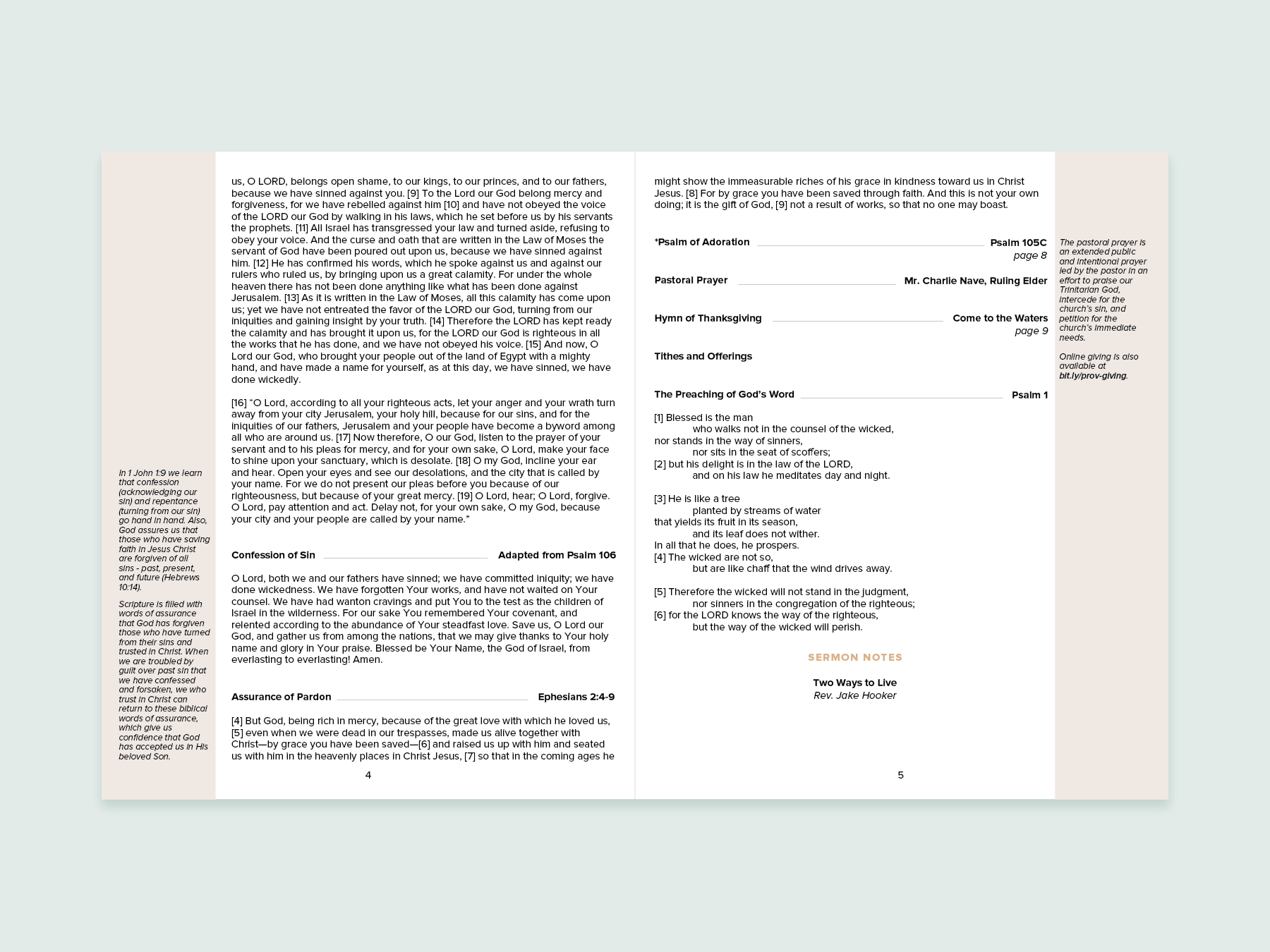
We’re told the blessed man is like “a tree planted by streams of water that yields its fruit in its season, and its leaf does not wither. In all that he does, he prospers.”
Have you ever walked upon a massive tree in the forest and wondered how long it had been there? So much history has taken place around the tree, but it’s remained a fixture in its place for hundreds of years. Storms have blown it around but it’s never been knocked down. Presidents, opinions, wars, have all come and gone, but that tree has never moved. That’s the blessed man. He’s a huge oak tree in the forest. He yields fruit. His leaf does not wither.
It really is a great metaphor for spiritual strength, stability, and endurance.
And one of the main reasons that tree has lasted so long is because it was planted directly beside a water source.
At our house we have the unique ability to basically kill any plant that you give to us alive, because, as I’ve been told, you’re supposed to water them from time to time. Who knew?
But in order for the tree to bear fruit and for its leaf to never wither it has to be well-watered.
As you read through the passage, the metaphor becomes crystal clear doesn’t it? A man who drinks from the soul-refreshing waters of the Word of God is able to discern the way of the righteous and is ultimately blessed. The Psalmist goes even further at the end of verse 3 and says, “In all that he does, he prospers.”
That doesn’t mean that everything in his life always goes exactly according to plan. Psalm 1 isn’t teaching that if you have a 25 day Bible reading hot-streak then good things are going to suddenly start happening to you. We all know that isn’t true. That’s not the way the world works.
What the Psalmist is teaching is something deeper: lasting contentment and peace grow where a life is ordered in delightful submission to God’s Word. True prosperity is not found in perfect circumstances, but in a heart firmly planted beside the stream of God’s truth.
Is that how people would describe you? Content? Steady? Faithful? Peaceful?
The Path of the Wicked (vv. 4–5)
Or do people think of you as discontent? Uneasy? Scattered? Restless?
Because that’s the contrast that the Psalmist sets up for us. He compares and contrasts the blessed man with the wicked. The blessed man prospers in all that he does, but that’s not the case for the wicked.
Whereas the blessed man is like a firmly planted tree, the wicked are like chaff that is driven away by the wind. Chaff is the useless part of the crop that gets thrown out or blown away during the threshing process. It’s the stuff that floats away into the air that no one cares about.
The wicked are like chaff. They have no roots. Their commitments are in the common wisdom of the age which seems to change every fifteen minutes! There are no root systems or water-source. They simply float in the air and are driven to and fro.
When trouble comes, they collapse under the weight of difficulty. When temptations blow, they are scattered by the slightest pressure. Their lives lack stability, purpose, and nourishment because they have built themselves on shifting sands. Unlike the tree planted by streams of living water, their influence and joy are fleeting, leaving no lasting legacy behind. Their path leads only to emptiness, and ultimately, ruin.
One life is rooted and enduring, the other is temporary and destined to be carried away.
That’s what a life detached from God looks like. There’s nothing to it. It’s vapid. It’s devoid of meaning. It may look carefree, but scratch a little beneath the surface and you’ll quickly realize that there’s nothing there.
In fact, when the wicked are put under the microscope of God’s righteous judgment, they cannot stand. They have nothing to plead, nothing to lean on, nothing to secure their place among the righteous. When the truth of God exposes the heart, every false confidence is stripped away.
And really, to be fair, none of us can withstand the scrutiny of God’s holy judgment on our own. Even the strongest, most fruitful Christian tree cannot stand there by personal merit. If we are left to stand before God on the basis of our own righteousness, we fall with the rest. That’s why our hope cannot ultimately be in our growth, our devotion, or our discipline. At the end of the day, we all need Jesus—His righteousness, His obedience, His standing before the Father—to be counted among the blessed. If there was ever a man who did perfectly embody what Psalm 1 describes it would be Jesus Christ!
The God Who Knows Both Paths (v. 6)
A buddy of mine from college is the grandson of Richard Petty. The King of NASCAR. And one day I was walking to class and I saw the black cowboy hat, the dark sunglasses, and the huge belt buckle — Richard Petty in the flesh. Suddenly, I had a crisis on my hands: Do I stop him and ask for a picture or do I leave him alone so he can see his grandson in peace? I chose to leave him alone — because I didn’t know him and I didn’t want to bother him.
The Lord never feels that way, because he knows the thoughts and hearts of all men. He knows where you stand before Him, He knows where I stand before Him. “The Lord knows the way of the righteous, but the way of the wicked will perish.” The term “to know” that’s used in verse 6 is used to describe marital intimacy. The Psalmist’s point is that God has an intimate, loving, knowledge of the righteous, but that knowledge strikingly absent from the wicked. Remember the words of our Savior: “And then will I declare to them, ‘I never knew you; depart from me, you workers of lawlessness.’”
One path leads to righteousness and life, while the other leads to destruction and ruin.
Dr. Martyn Lloyd-Jones tells a fascinating story in his book Preaching and Preachers. He was once offered an opportunity to debate a prominent British atheist on live television. On the surface, it seemed like an incredible opportunity: he could share the gospel, gain exposure, and elevate his church’s profile. Everyone around him encouraged him to accept.
And yet, he declined. Why? Because he understood that such a debate would make faith in Christ appear as if it were on equal footing with atheism. It would imply that both Christianity and atheism are two valid options. But nothing could be further from the truth. The path of the righteous leads to blessing, life, and fruitfulness. The path of the wicked leads to emptiness, instability, and ultimately, destruction. Presenting the two as parallel choices would have misrepresented the reality of God’s truth.
Which is exactly the way the Psalmist presents the two paths. They’re not equal options. Blessing and destruction are not the same. In fact, the Psalmist assumes that everyone is already on a path.
And that’s what you and I have to wrestle with this evening: which path are you on?
Are you trusting in Christ? Are you rooted in God’s Word, nourished by His truth, and delighting in His ways? Or are you like chaff, blown about by every wind of circumstance, empty and directionless, with no foundation to sustain us?
Psalm 1 calls us not merely to make a decision, but to examine our lives. It urges us to consider where we are already rooted and to recognize where the path we are traveling is leading. The psalm reminds us that true prosperity, joy, and life are not found in temporary pleasures or the ever-changing wisdom of the world, but in a life that delights in God’s Word, is sustained by His Spirit, and is firmly planted beside the streams of His truth. So the question before each of us is both simple and urgent: which path are you on? Are you drawing your life from the fountain of living water?
Amen. Let’s pray together.
