
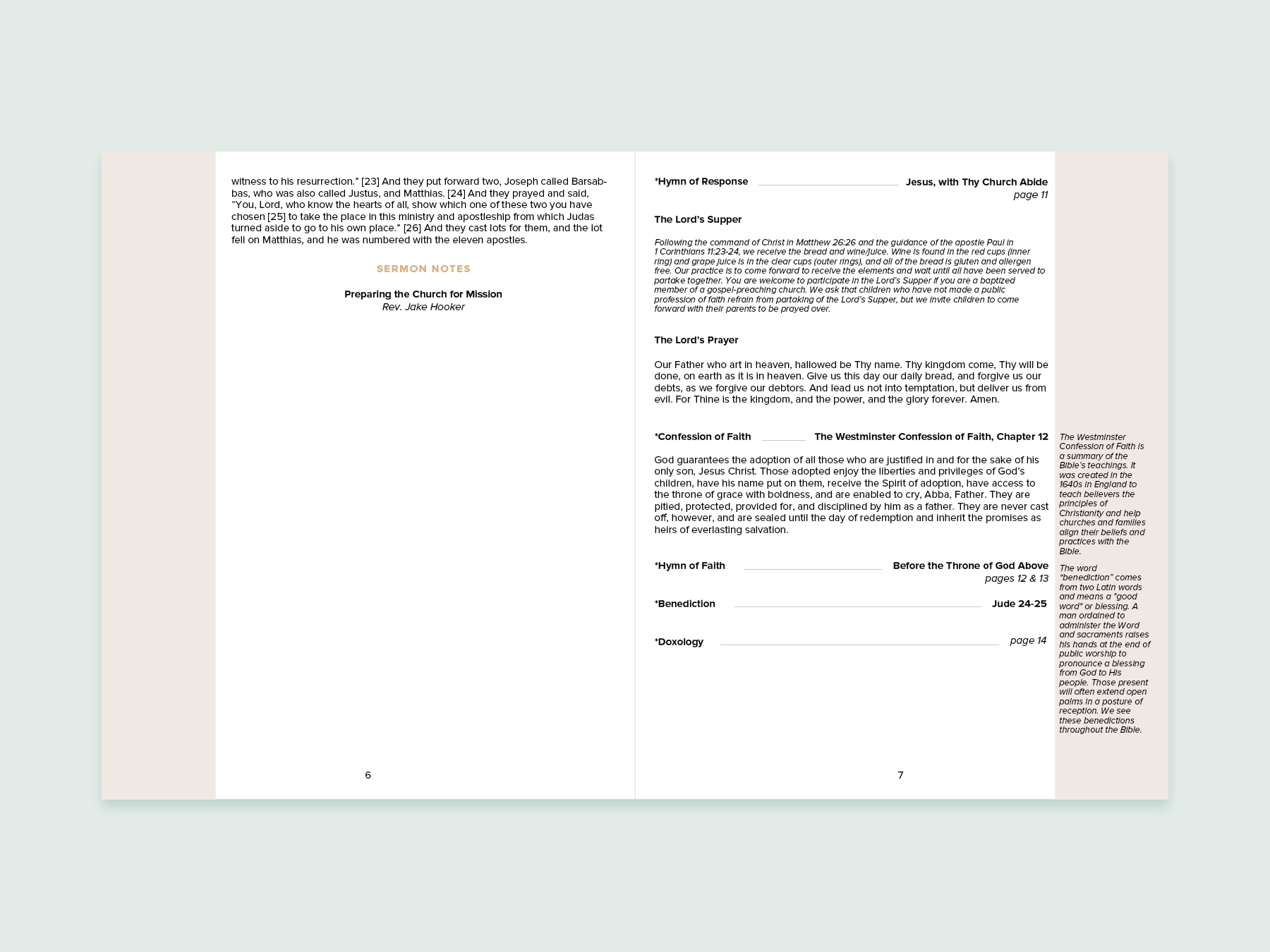
Preparing the Church for Mission - Acts 1:12-26
For most, when you think about the early chapters of the book of Acts your mind jumps straight to Pentecost. And rightfully so–it’s one of the most important events in all of redemptive history. At Pentecost, there’s rushing wind, there are tongues of fire, and three thousand people are saved! It’s super exciting!


And so when you compare that to the verses we just read, let’s be honest, this passage seems boring! The Apostles’ replace Judas Iscariot with Matthias! They were effectively sorting out some logistical issues. If you’re not careful you can just think of this passage as a filler that gets us from the Ascension to Pentecost.
But if that’s our mentality we’ll miss something incredibly obvious and important: Before Luke tells us about the extraordinary work of the Holy Spirit, he spends nearly an entire chapter describing the ordinary rhythms of the life of the church. They spend time in corporate prayer, seek direction from the Scriptures, and have a congregational meeting. Before Jesus sends His Spirit to empower the church, he first lays the foundation he’ll build his church upon. And that foundation consists of His church being devoted to prayer (vv. 12-14), governed by the Scriptures (vv. 15–20), and entirely dependent upon Him (vv. 21–26).
A Devotion to Prayer (vv. 12-14)
So keep in mind what’s just happened. Jesus has just ascended, but before he ascended he told his disciples to not depart from Jerusalem. They were supposed to stay there. Which is why they head from Olivet back to the same Upper Room where Jesus consecrated the Lord’s Supper. That Upper Room is where the early church gathered.
Luke lists all the disciples who he now refers to as Apostles. The list includes: Peter, John, James, Andrew, Philip, Thomas, Bartholomew, Matthew, James, Simon the Zealot, the other Judas, and the son of James. Obviously, there are only eleven Apostles because of Judas Iscariot, who they replace with Matthias. We’re also told that there were many women present in the upper room including Mary.
There’s also evidence that the early church may have been baptists because Luke was taking attendance and reports there were about 120 people present. That’s a little Sunday morning joke to make sure you’re awake this morning.
In all seriousness, the picture that you get from all this information that Luke reports is a very ordinary church gathering. And it’s what the church does, that we really need to pay attention to. Notice they didn’t immediately hit the streets preaching. Nor did they organize a tent revival or some sort of evangelistic campaign.
The first activity of the New Testament church is prayer.
In fact, Luke says that they "[devoted] themselves to prayer." The key word in verse 14 is “devoting.” The Greek word is proskartereō, which means "to persist in," "to be intently engaged in," or "to attend constantly to."
In other words, this wasn't one of those prayer meetings where anyone was guilt tripped into attending. No one had to twist their arms. They persisted in prayer because they recognized just how desperately they needed the Lord.
The real reason Luke reports the count of 120 people in the upper room in order to demonstrate just how humble the beginnings of Christianity were. The greatest movement the world has ever seen began with 120 people devoting themselves to prayer.
Because when you step back and think about the task of, “bearing witness to Jesus to the ends of the earth,” it seems impossible! And humanly speaking, it was, and remains impossible. Apart from the outpouring of the Holy Spirit, this rag-tag group of people couldn’t build Christ’s kingdom by their own strength.
The Apostles’ and everyone there in the upper room certainly recognized this meant that the only faithful thing they could do was to wait upon the Lord in prayer. It’s worth noting that before a single sermon was preached, a powerful miracle was ever performed, they first bowed their heads in humble dependence upon their ascended King.
The early church is situated in redemptive history between Christ’s ascension and his return, which is exactly where you and I remain today. There’s a temptation to look back at the early church and think, “those times were completely different!” And of course, to a certain extent that is true. We’re not living under the rule of the Roman Empire.
But the mission has never changed. You and I are still called to “bear witness to Jesus Christ to the ends of the earth.” And it seems to me that that mission remains every bit as daunting today as it was then. And the need for an outpouring of the Holy Spirit is every bit as relevant today as it was then.
At the end of the day, the solutions to the political, moral, and social issues we read about and encounter in our daily lives are not better legislation, education, or economic policy, but the transforming power of the gospel. Laws can restrain evil, education can cultivate wisdom, and good policies can promote justice, but none of them can change the human heart.
So what can we do as a church?
The same thing the early church did there in the upper room — pray. We must pray. Pray privately. Pray with your family. Pray with your church. We must be a praying people, because you and I are powerless to accomplish the mission that Christ has given apart from the working of the Holy Spirit.
Notice one of the other things that Luke reports for us from the upper room. They were “with one accord.” They were unified. Which is different from uniformity. These men and women came from different backgrounds, had different personalities, and undoubtedly held different opinions on all sorts of matters. Yet they were united around the mission and their desperate need for the Holy Spirit.
This is where every healthy church starts: unity over the mission and a devotion to prayer. Prayer isn’t the warm up before ministry. Prayer is ministry, because when the church prays we’re effectively confessing “we cannot do this without Jesus.” A church devoted to prayer will also be a church devoted to preserving "the unity of the Spirit in the bond of peace."
Governed By the Scriptures (vv. 15–20)
Notice what happens next: after a season of prayer, Peter stands to preach. And what does he appeal to? He doesn't appeal to his own experience. He doesn't appeal to someone's opinion. Nor does he appeal to tradition. He appeals to the Scriptures.
And he points to the Scriptures in order to prove that Judas’ betrayal wasn’t some sort of unexpected detour in God’s plan.
But before he quotes the Psalms, Luke includes a parenthetical explanation about Judas' death—a detail that has always intrigued readers. Luke tells us that Judas indirectly purchased the field when he returned the thirty pieces of silver to the chief priests and elders, who then used the money to buy a burial place for foreigners that became known as the "Field of Blood."
Matthew tells us that Judas hanged himself. So when Luke adds the graphic description that Judas "burst open in the middle and all his bowels gushed out," most scholars understand the two accounts to be complementary rather than contradictory. After Judas hanged himself, his' body evidently fell—either because the rope or branch gave way or because his body decomposed—and struck the ground with such force that Luke's description followed.
But nevertheless, Peter’s point here is that everything that happened concerning Judas’ betrayal of Jesus was all in accordance with God’s plan. And he quotes from two Psalms to make his point. He quotes Psalm 69 and 109.
Given the context, Peter's quotation from Psalm 109:8 makes sense: "Let another take his office." He's explaining why Judas must be replaced. But the quotation from Psalm 69 is less obvious: "May his camp become desolate, and let there be no one to dwell in it." Why does Peter bring up that verse?
The answer is that Psalm 69 is a Messianic Psalm. Peter understood David to be a type of Christ, so David's experience often foreshadowed Jesus' own. In Psalm 69, David speaks as one who has been hated and betrayed. Just as David was betrayed by those close to him, Jesus was betrayed by Judas.
Peter applies Psalm 69:25 to Judas. By saying, "May his camp become desolate," he is showing that Judas had come under God's judgment and because of that, his position has been vacated. Which naturally leads to the next quotation from Psalm 109: "Let another take his office." In other words, because Judas' office has been opened up by God's judgment, it must now be filled by another.
But what I don't want any of us to miss is Peter's instinct. Just consider what's happening in this passage. Beyond Jesus telling them to return to Jerusalem and wait, they don't have a great deal of information. They know the Holy Spirit is coming, but they don't know when. They don't know what it will look like. They don't know exactly how Christ intends to build His church. Humanly speaking, they are standing at the threshold of an entirely new era in redemptive history.
So where does Peter turn for guidance? He doesn’t let his emotions guide what happens next. He doesn't call a strategy session with the other disciples to figure out how to move forward. Nor does he stand up and say “y’all need to listen to me because I’m the pope now.” He opens the Scriptures. He goes to the Psalms in order to figure out what to do next.
The early church was every bit as dependent upon God's Word as we are today. And frankly, this provides a great litmus test when evaluating churches. Are they guided and submitted to the Word of God? Is that where they turn when trying to figure out what to do next? Or is it all paid consultants trying to read the overall trajectory of our culture?
Certainly, there is a place for wisdom, careful planning, and learning from others. But none of those things can ever replace the authority and sufficiency of Scripture. The church was never designed to be governed by market research, demographic trends, or the latest leadership strategies. She is governed by the voice of her Shepherd speaking through his, inerrent, infallible, Word. When churches become more captivated by cultural analysis than biblical revelation, we shouldn’t be surprised when they inevitably begin drifting from the mission Christ has given them.
Healthy churches continually ask, "What has God said?" before they ask, "What seems to work?
Obviously, that’s true for the church, but it’s also true for each of us as individuals as well. When you’re faced with difficulty, confusion, or uncertainty, where do you turn? Do you immediately jump on the internet, talk with friends, or just go with your gut? Or do you search the Scriptures for answers?
The church's authority would never rest in an individual or popular opinion—it would always rest in the inspired, authoritative, and sufficient Word of God. Before Christ sent His church into the world, He rooted His church firmly in the Scriptures.
Depend Entirely Upon Him (vv. 21–26)
In these final verses, we come to what is, for lack of a better term, the church's first congregational meeting. The question before them is simple: Who is qualified to replace Judas?
But before we answer that question, there's a more foundational one lurking in the background: Why did Judas need to be replaced at all? Would it really have mattered if there were only eleven apostles instead of twelve?
The answer is yes—it mattered a great deal.
Throughout the Old Testament, the number twelve represented the fullness of God's covenant people. Israel consisted of twelve tribes, descended from the twelve sons of Jacob. So when Jesus deliberately appointed twelve apostles, he wasn't haphazardly choosing the size of his leadership team. He was signaling that he had come to gather in all of God’s people under the new covenant.
That's why it was so important that the apostolic band be restored to twelve before Pentecost. The Twelve were the foundational witnesses of the new covenant church, corresponding to the twelve tribes of Israel. Eleven apostles would have effectively communicated—that Jesus was going to leave some of his people behind! When the truth is, He will gather all of his covenant people and lose none of those the Father had given him.
God never leaves his people behind. The Good Shepherd seeks the one lost sheep until he finds it. Not one of Christ's sheep will be missing from his flock. And so, before the church begins its worldwide mission, the number of the apostles is restored to twelve, proclaiming that God's saving purpose for his people is complete and certain.
And so Peter also gives us the qualifications for an apostle. He says in verses 21-22 that an apostle had to be someone "who accompanied us during all the time that the Lord Jesus went in and out among us, beginning from the baptism of John until the day when he was taken up from us." Luke then records Peter's conclusion: "One of these men must become with us a witness to his resurrection."
In other words, an apostle had to be someone who had accompanied Jesus throughout his earthly ministry—from the beginning of John's ministry until Christ's ascension—and who could personally testify as an eyewitness to the resurrected Lord. And so, the apostles’ authority rested not on personal ability or popularity, but on the fact that they had seen the risen Christ and were uniquely commissioned to bear witness to him.
In case you’re wondering, it’s for this reason, the office of apostle no longer exists today. Believe it or not, everyone who was an eyewitness of Christ’s earthly ministry has passed into glory.
But notice that the criteria for appointing another apostle had nothing to do with who was the most gifted preacher, or the wealthiest donor, or the best organizer. They were looking for someone who Christ had already prepared.
And based upon that criteria, it came down to two men: “Joseph called Barsabbas, who was also called Justus, and Matthias.”
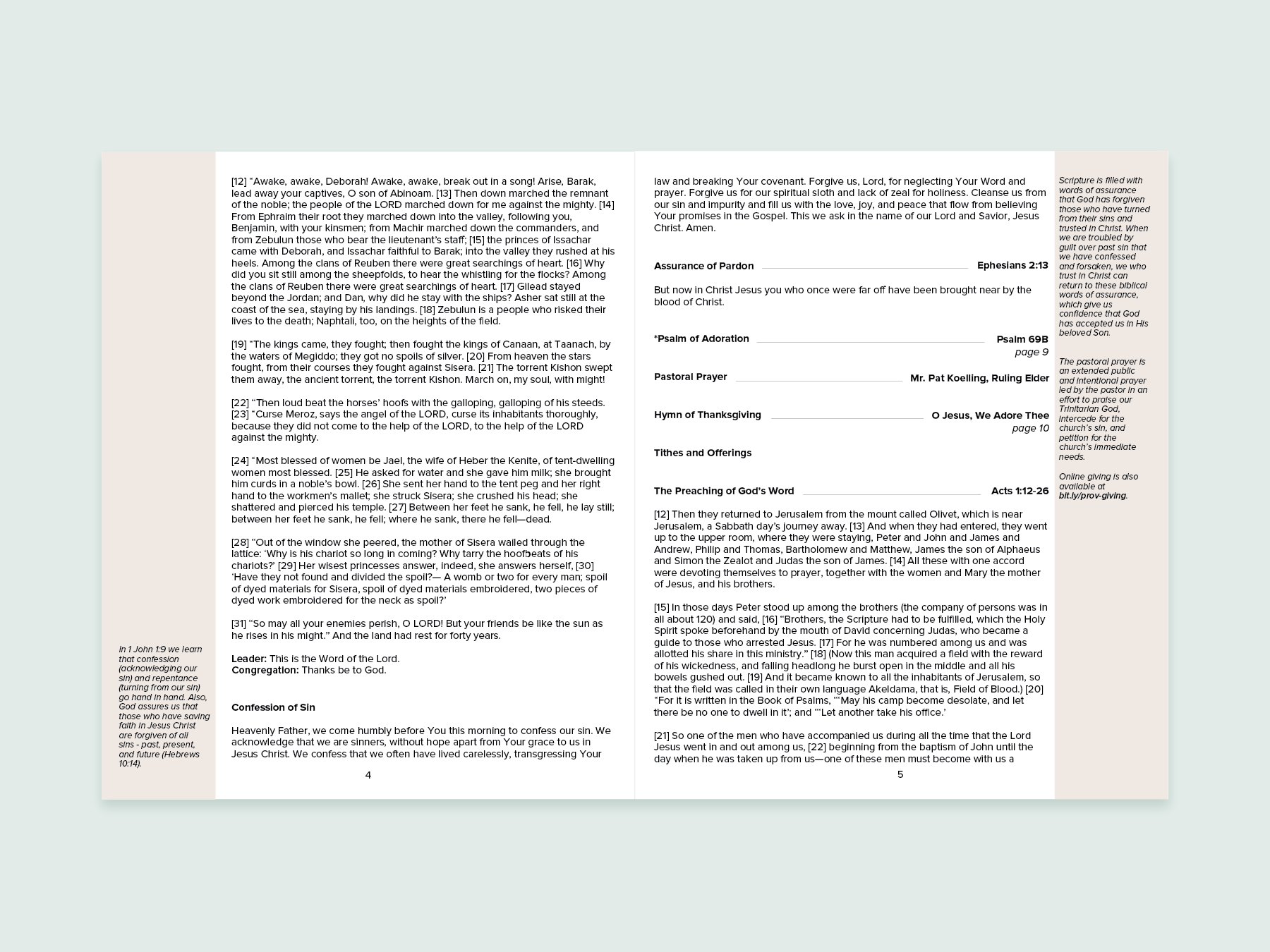
Once they had narrowed it down to those two men, they then turned once again to the Lord in prayer. “You, Lord, who know the hearts of all, show which one of these two you have chosen 25 to take the place in this ministry and apostleship from which Judas turned aside to go to his own place.”
The important thing to notice in their prayer is their dependence on God’s sovereignty. “You, Lord, who know the hearts of all, show which one of these two you have chosen 25 to take the place in this ministry and apostleship…”
Which is why they cast lots. For the record, the point of casting lots isn't to teach the church that we should make important decisions by rolling dice or drawing straws. Rather, the casting of lots was a way to demonstrate their utter dependence upon the Lord.
And of course, it fell upon Matthias.
The whole process was meant to highlight their dependence upon the Lord. That is the point.
Notice that the apostles didn't simply cast lots and hope for the best. They identified the biblical qualifications for the office. They nominated men who met those qualifications. They prayed, acknowledging that the Lord alone knows the hearts of all people. Then, and only then, they cast lots, entrusting the final decision to God's sovereign providence. As Proverbs 16:33 reminds us, "The lot is cast into the lap, but its every decision is from the Lord."
They were depending on the Lord!
The church remains just as dependent upon the Lord today. While we no longer cast lots to discern God's will, our dependence upon him has not diminished. If anything, it has deepened. If we hope to accomplish anything of lasting, eternal significance, we must continually seek the Lord through prayer and faithfully submit ourselves to his Word. The church's strength has never come from human ability, impressive personalities, or clever strategies. It comes from the Lord working through ordinary means and ordinary people who are utterly dependent upon him.
Not long ago, I read a biography entitled The Pastor of Kilsyth, which tells the story of a Scottish minister named William H. Burns. And what is striking about Burns is how ordinary his ministry appeared by human standards. He did not pastor a large, influential church. He was not known as a brilliant academic or a gifted public figure. By all appearances, he was simply a faithful pastor laboring in an ordinary place.
And yet, in 1839, after years of faithful ministry, his congregation entered into an extended season of prayer. They gathered together, seeking the Lord and asking him to move among them. And from that place of prayer, revival began to spread throughout Kilsyth. At one point during that remarkable season, thousands of people stood outside in the cold and rain simply to hear Burns preach the Word of God.
What changed Kilsyth was not a new strategy or a remarkable personality. It was the Lord answering the prayers of his people. The same God who guided the early church in Acts is still the God upon whom his church depends today.
Notice what Luke has done. Before Pentecost, before the miracles, before thousands are converted, before churches are planted throughout the Roman Empire, Christ is quietly laying the foundations of the church: A devotion to prayer. A commitment to the Scriptures. And an utter dependence on Him.
None of these things are extraordinary. There is nothing here that is reserved for a select few churches. Every church should be committed to the things that we read in these verses.
Providence Presbyterian Church does not need to invent a new strategy to change the world. We do not need to become something Christ never intended his church to be. We simply need to rely upon the things that the Lord has already given us.
Are we really committed to reaching the lost? Are we really committed to expanding Christ’s kingdom? Then we must pray. We must submit ourselves to the Word of God. We must recognize our helplessness apart from the Lord.
And frankly, this should encourage all of us this morning. Are you spiritually dry? Are you weary? Do you feel as though you've wandered or lost your joy in Christ? Remember, your hope is not found in trying harder or manufacturing spiritual excitement.
Your hope is found in a Savior who has not changed. The ascended Christ still intercedes for his people. He still speaks through his Word. He still hears our prayers. The One who faithfully prepared his first disciples has not stopped preparing his people today. He is faithful, and he will finish the work he has begun in you.
Amen. Let’s pray together.
